Home/oracle/Free Oracle 1Z0-076 Certification Actual Exam Questions
Free Oracle 1Z0-076 Certification Actual Exam Questions
The questions for this exam were last updated on January 7, 2026
Dumps Box (DumpsBox) offers up-to-date practice exam questions for 1Z0-076 certification exam which are developed and validated by Oracle subject domain experts certified in Oracle 1Z0-076 Certification . These practice questions are update regularly as we keep an eye on any recent changes in 1Z0-076 syllabus, and when there is update our team quickly adjusts the questions. This commitment to providing the best quality exam prep material to certification aspirants is what makes DumpsBox.com the best certification exam prep website. On top of that, our strong, yet strictly moderated, community based feedback keeps the content clean and current. Each question has helpful community discussion that provides it extra perspective and introduces helpful resources for better exam preparation. This also saves students from other outdated practice questions or illicit exam dumps that can have adverse affects on career. Browse through our Oracle 1Z0-076 Certification exam questions and pass your exam on first try.
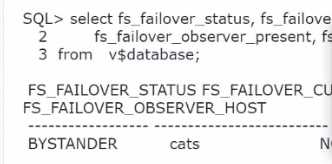
Examine this query and its output: Which two statements are true?
Select all that apply, then reveal solution.
Question No. 2
You created two remote physical standby databases using SQL and RMAN. The primary database is a four-instance RAC database and each physical standby database has two instances. Roles-based services are used for client connectivity and have been defined in the Grid Infrastructure. Consider these operational requirements: • The ability to manage multiple standby databases with a single tool • The simplification of switchovers, failovers, reinstatements, and conversions to and from snapshot standby databases • The automation of failovers to a specified target standby database Which TWO tools can be used to fulfill these requirements7
Select all that apply, then reveal solution.
Question No. 3
Examine the Data Guard configuration: DGMGRL> show configuration; Configuration - Animals Protection Mode: Max Availability Databases: dogs - Primary database sheep - Physical standby database cats - Physical standby database Fast-Start Failover: DISABLED Configuration Status: SUCCESS An attempt to enable fast-start failover raises an error: DGMGRL> enable fast_start failover; Error: ORA-16693: requirements not met for enabling fast-start failover Failed. Identify three possible reasons for this error.
Select all that apply, then reveal solution.
Question No. 4
Your expertise is requested for these customer requirements: The Data Guard environment must be in maximum protection mode. Reports must be offloaded to a physical standby database. There must be no lag between the primary and standby databases that affect the reports produced. The primary database must be resilient in case of a single network failure. Which solution is correct for these requirements?
Select one option, then reveal solution.
Question No. 5
Which THREE steps are prerequisites for the creation of a physical standby database on a separate server using the RMAN active database duplication method?
Select all that apply, then reveal solution.
Question No. 6
You must design an Oracle Data Guard configuration for a DSS database that meets these permanent requirements: 1. Creating and maintaining bitmap indexes should not impact the performance of the primary database. 2. Creating and maintaining materialized views should not impact the performance of the primary database. Additionally, there are these requirements, only one of which is ever done at any one time: 1. It should be possible to apply designated patches with a minimum amount of downtime. 2. Upgrading to a new database release should be performed with the least possible amount of downtime. 3. New application software releases should be tested against an exact and up-to-date replica of the primary database. Which configuration meets these requirements with the fewest of databases?
Select one option, then reveal solution.
Question No. 7
Which THREE are among the various tasks performed by the Data Guard Monitor (DMON) process?
Select all that apply, then reveal solution.
Question No. 8
Which THREE are true about using flashback database in a Data Guard environment?
Select all that apply, then reveal solution.
Question No. 9
In Oracle Database 19c, you can set the value of database initialization parameters in a database using the EDIT DATABASE... SET PARAMETER Command: DGMGRL> EDIT DATABASE 'boston' SET PARAMETER log_archive_trace - 1; Which THREE statements are TRUE about the command?
Select all that apply, then reveal solution.
Question No. 10
You are licensed to use Oracle Active Data Guard. Which TWO statements are true after enabling block change tracking on a physical standby database?
Select all that apply, then reveal solution.
Question No. 11
You detected an unrecoverable archive gap in your data guard environment. So, you need to roll standby. forward in time without applying a large number of archive log files using this command: RMAN> RECOVER STANDBY DATABASE FROM SERVICE-; When running this command, which of the following steps can be performed automatically? 1. Remember all data file names on the standby. 2. Restart standby in nomount. 3. Restore controlfile from primary. 4. Mount standby database. 5. Rename data files from stored standby names. 6. Restore new data files to new names. 7. Recover standby.
Select one option, then reveal solution.
Question No. 12
Which TWO statements are true regarding Data Guard Broker?
Select all that apply, then reveal solution.
Question No. 13
Which three are true about using RMAN in a Data Guard environment?
Select all that apply, then reveal solution.
Question No. 14
Your Data Guard environment contains a four-instance RAC primary database whose SID is PROD and a RAC physical standby database whose std is PROD_SBY. Examine the command executed on a node of the primary database cluster to create a service OLTPWORKLOAD that the applications will use to connect to the database when it is in the FRlMARYTclatabase role: srvctl add service -db PROD -service oltpworkload -role PRIMARY -failovertype SESSION - failovermethod BASIC -failoverdelay 10 -failoverretry 150 The service is then started Consider this list of tasks: 1. On a node of the standby database cluster execute: srvctl add service -db PROD_SBY -service oltpworkload -role PRIMARY -failovertype SESSION - failovermethod BASIC -failoverdelay 10 -failoverretry 150 2. On the primary database, create the oltpworkload database service using the dbms_service.create_service procedure. 3. Configure tap for clients in the tnsnames.ora files. 4. Make sure clients use the OLTPWORKLOAD service to connect to the database instances. 5. On the standby database, create the oltpworkload database service using the dbms_service.create_servi;l procedure. Identify the required steps to configure and use Transparent Application Failover (taf).
Select one option, then reveal solution.
Question No. 15
Which two are true about database roles in an Oracle Data Guard configuration?