Free Actual Microsoft Azure AZ-204 Actual Exam Questions - Question 5 Discussion
DRAG DROP You are a developer for a software as a service (SaaS) company that uses an Azure Function to process orders. The Azure Function currently runs on an Azure Function app that is triggered by an Azure Storage queue. You are preparing to migrate the Azure Function to Kubernetes using Kubernetes-based Event Driven Autoscaling (KEDA). You need to configure Kubernetes Custom Resource Definitions (CRD) for the Azure Function. Which CRDs should you configure? To answer, drag the appropriate CRD types to the correct locations. Each CRD type may be used once, more than once, or not at all. You may need to drag the split bar between panes or scroll to view content. NOTE: Each correct selection is worth one point. 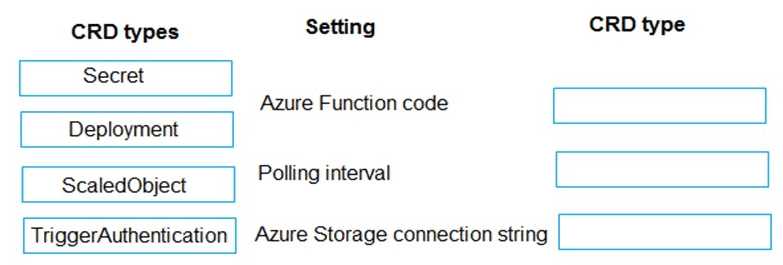
ScaledObject defines scaling, TriggerAuthentication secures queue access, so both are needed.
ScaledObject sets the scaling rules based on queue length, so it’s essential. TriggerAuthentication handles secure access to the storage queue, so both are needed. The others don’t fit this scenario.
I agree that ScaledObject is key since it configures when and how the function scales based on queue length. TriggerAuthentication also makes sense because it stores the credentials needed to access the Azure Storage queue securely. I don’t see any need for the other CRDs like ClusterTriggerAuthentication here, since this seems like a regular namespace-scoped setup without cluster-wide triggers. So putting ScaledObject and TriggerAuthentication in the right spots matches what KEDA requires for scaling with Azure queues.
I think you definitely need the ScaledObject CRD since that’s what tells KEDA how to scale based on the queue length. TriggerAuthentication is a must too because it handles the Azure Storage queue credentials securely. It seems like the question doesn’t mention anything about external secrets or other resources, so no need for things like ClusterTriggerAuthentication or other CRDs here. So, sticking with just ScaledObject and TriggerAuthentication makes sense for this scenario.
ScaledObject for scaling and TriggerAuthentication for queue credentials, no extras needed.
ScaledObject for scaling and TriggerAuthentication for secure access to the queue.
Seems pretty straightforward, they want KEDA ScaledObject and TriggerAuthentication here.