Free Actual Microsoft Azure AZ-204 Actual Exam Questions - Question 13 Discussion
HOTSPOT You are developing a solution by using the Azure Event Hubs SDK. You create a standard Azure Event Hub with 16 partitions. You implement eight event processor clients. You must balance the load dynamically when an event processor client fails. When an event processor client fails, another event processor must continue processing from the exact point at which the failure occurred. All events must be aggregate and upload to an Azure Blob storage account You need to implement event processing recovery for the solution. Which SDK features should you use? To answer, select the appropriate options in the answer area. Each correct selection is worth one point. 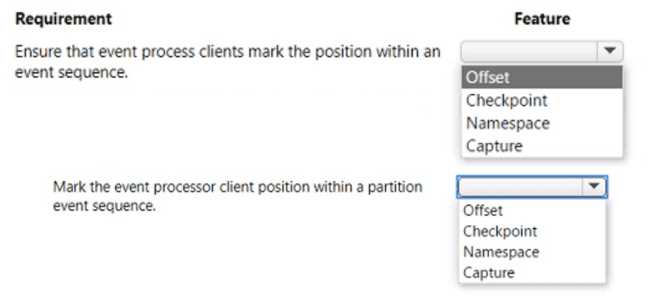
Partition ownership handles rebalancing after a failure, and checkpointing ensures no events get reprocessed. Without both, you risk missing data or duplication. So those two are definitely the key features here.
Partition ownership tracks who processes which partitions, so when one fails, another can take over seamlessly. Checkpointing makes sure processing restarts exactly from the last event processed. Both fit the dynamic failover need perfectly.
Partition ownership lets processors rebalance when one fails, checkpointing resumes exactly where left off.
Besides partition ownership and checkpointing, I’d emphasize the importance of using the Event Processor Client from the Azure SDK. It’s designed to handle partition distribution and checkpointing automatically, so it simplifies failover and recovery. Manually managing these would be a pain and error-prone. Also, the checkpointing feature ensures precise recovery points, which is critical to not lose or duplicate events when a client fails. So even though partition ownership and checkpointing are core, make sure you’re leveraging the SDK’s event processor client since it integrates both featur
I think partition ownership is key here because it lets the Event Processor clients claim partitions and redistribute them when one client fails. That way, the other processors take over automatically. Then the checkpointing feature makes sure processing resumes right where it left off by storing the last read event position. Without checkpointing, you risk reprocessing or missing events after a failover. So selecting both partition ownership and checkpointing makes sense to handle dynamic balancing and recovery seamlessly. The Blob storage is probably where you store the checkpoints for durab
Partition ownership helps evenly split partitions among processors, so yes for load balancing.
Checkpointing and partition ownership are a must here for recovery and load balancing.