Free Microsoft AZ-140 Actual Exam Questions
Dumps Box (DumpsBox) offers up-to-date practice exam questions for AZ-140 certification exam which are developed and validated by Microsoft subject domain experts certified in Microsoft AZ-140 . These practice questions are update regularly as we keep an eye on any recent changes in AZ-140 syllabus, and when there is update our team quickly adjusts the questions. This commitment to providing the best quality exam prep material to certification aspirants is what makes DumpsBox.com the best certification exam prep website. On top of that, our strong, yet strictly moderated, community based feedback keeps the content clean and current. Each question has helpful community discussion that provides it extra perspective and introduces helpful resources for better exam preparation. This also saves students from other outdated practice questions or illicit exam dumps that can have adverse affects on career. Browse through our Microsoft AZ-140 exam questions and pass your exam on first try.
storage account named storage1.
You have an Azure Virtual Desktop deployment that contains a host pool named Pool1. Pool1
contains session hosts that are Microsoft Entra joined.
You plan to implement FSLogix profile containers for the session hosts of Pool1.
In storage1, you create a new Azure Files share named share1.
You need to ensure that share! can store the FSLogix profile containers.
What should you enable for share!?
Probably D could work here since FSLogix profile containers need strong security on the Azure Files share to protect user data. Setting the security profile to Maximum security might ensure SMB encryption and more stringent controls are in place. This feels like a safer bet compared to just compatibility mode, which might not enforce the needed protections for user profiles. Plus, if Kerberos were enough on its own, they might have said so directly, but this points to a combination of strong security settings being required.
C. FSLogix profile containers need Kerberos authentication to securely access Azure Files on Entra joined hosts, so enabling Microsoft Entra Kerberos is essential here. Other options don’t provide the necessary authentication protocol.
HOTSPOT You need to recommend a DNS infrastructure that meet the performance requirements. What should you recommend? To answer, select the appropriate options in the answer are a. NOTE: Each correct selection is worth one point. 
I’d also exclude B since internal DNS won’t improve external query speed. A is designed for low-latency, global DNS resolution which fits the performance need. C adds failover options, so it’s key for keeping DNS responsive if something goes wrong. Together, A and C make the most sense to cover fast and reliable DNS.
I’d drop B quickly since it’s internal and won’t help with external performance. A handles global load well, and C provides backup, so together they cover speed and reliability.
requirements.
Which two actions should you perform? Each correct answer presents a complete solution.
NOTE: Each correct selection is worth one point.
E/D? NSGs paired with app security groups give granular control, especially on inbound traffic, which is key for both security and performance. It feels more lightweight than doubling up on firewalls.
F and B make sense—using one firewall with outbound traffic filtering keeps it efficient.
Windows Server and is deployed to the West US Azure region.
You deploy a new Azure Virtual Desktop host pool named HostPool1 to the East US Azure region.
You need to ensure that all the traffic between HostPool1 and Server1 is routed via the Microsoft
backbone network.
What should you use?
B vs A, but service endpoints are mostly for Azure PaaS, so B fits cross-region VNet communication better.
This one seems pretty clear to me: B, virtual network peering. Since Server1 and HostPool1 are in different regions, peering their VNets ensures traffic uses the Microsoft backbone. Service endpoints (A) work within the same region, so they don’t really help here. Routing tables (C) just control routing but can’t force traffic onto Microsoft’s network, and Traffic Manager (D) is more for load balancing across endpoints, not controlling routing paths. So for cross-region secure traffic inside Azure, peering is the way to go.
You identify the network latency between the locations where users reside and the planned
deployment.
What should you use to identify the best Azure region to deploy the host pool?
It’s B because Experience Estimator predicts user experience before deployment, unlike Traffic Manager.
Actually, B makes more sense here since the Experience Estimator is designed to simulate user experience and latency before deploying, unlike Traffic Manager which handles live traffic routing after deployment.
DRAG DROP Which host pool design and which service should you configure to meet the disaster recovery requirements? To answer, drag the appropriate solution to the correct requirements. Each solution may be used once, more than once, or not at all. You may need to drag the split bar between panes or scroll to view content NOTE: Each correct selection is worth one point. 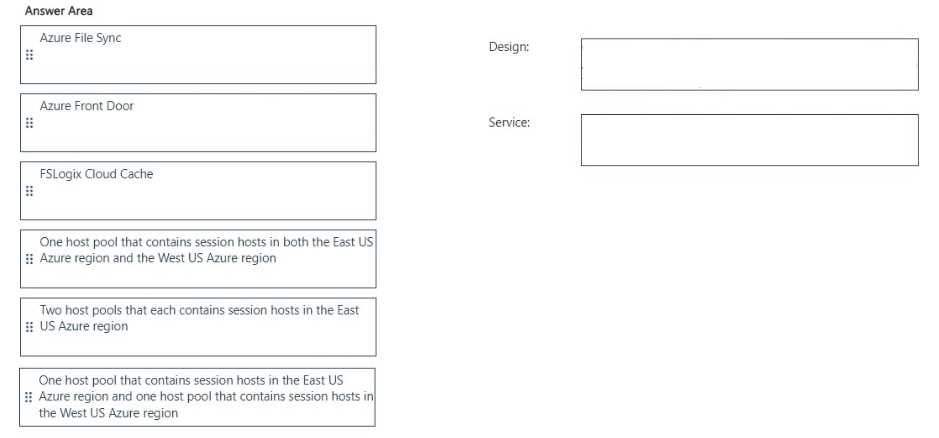
I’d pick B for the host pool since it talks about redundancy, which fits disaster recovery, and C for the service because it supports failover. The others don’t mention recovery specifics as clearly.
B looks best for host pools since it’s about redundancy, not just scaling.
DRAG DROP - Your on-premises network contains an Active Directory domain named fabrikam.com that syncs with Azure Active Directory (Azure AD). The domain contains a global group named AVDusers. You have an Azure subscription that contains the resources shown in the following table. 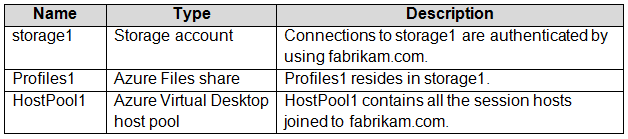 All Azure Virtual Desktop users are members of the AVDusers group. You plan to create FSLogix profile containers in Profiles1. You need to configure Profiles1 and fabrikam.com to ensure that the HostPool1 sessions hosts can access the FSLogix profile containers. What should you do? To answer, drag the appropriate configurations to the correct targets. Each configuration may be used once, more than once, or not at all. You may need to drag the split bar between panes or scroll to view content.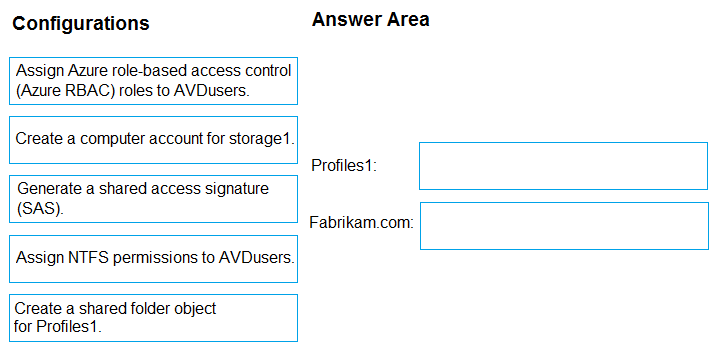
Assign AVDusers Storage Blob Data Contributor on Profiles1 for access rights.
I’d check if the HostPool1 VMs have a managed identity and assign that identity Storage Blob Data Contributor on Profiles1. That way, session hosts get direct access without involving user groups.
You need to recommend a solution to run containerized applications without installing the
applications on the session hosts.
What should you include in the recommendation?
D. MSIX app packages definitely stand out because they’re designed to run apps in a containerized way without full installs, which fits the AVD scenario well. The other options are more about traditional installs or packaging, so they don’t really solve the requirement of avoiding installs on the session hosts. MSIX also supports modern app delivery and management, making it a better match for containerized environments in Azure Virtual Desktop.
D imo. The question’s about running containerized apps on AVD without installing on session hosts, and MSIX app packages are designed for that kind of virtualized deployment. The other options are more traditional installation formats, so they don’t really fit the containerized angle. MSIX lets you package apps with isolation, which sounds exactly like what’s needed here.
DRAG DROP You have an Azure subscription that contains the storage accounts shown in the following table. 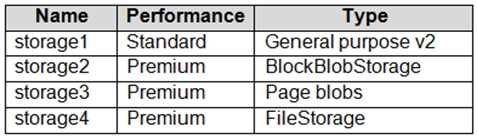 You have a custom generalized Windows 10 image. You plan to deploy an Azure Virtual Desktop host pool that will use the custom image and FSLogix profile containers. You need to recommend which storage accounts to use for the custom image and the profile containers. The solution must meet the following requirements: Minimize costs to store the image. Maximize performance of the profile containers. Which account should you recommend for each type of content? To answer, drag the appropriate accounts to the correct content type. Each account may be used once, more than once, or not at all. You many need to drag the split bar between panes or scroll to view content. NOTE: Each correct selection is worth one point.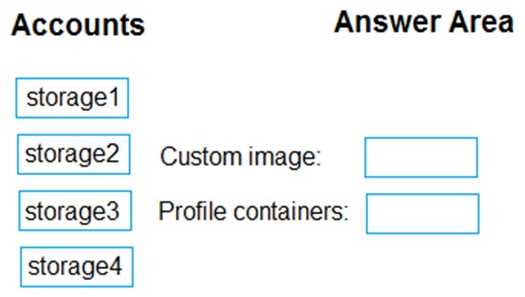
Cool storage is cheaper for images, Premium for faster profile container access.
Avoid starting with snapshot (trap), better to register and enable backup first.
You have an Azure Storage account named store 1 that stores FSLogix profile containers in a share
named profiles. You need to configure the path to the storage containers for the session hosts Which
path should you use?
Maybe B is right since the path has to be a proper UNC path for SMB access, and using the file.core.windows.net endpoint fits that need. The other options look like URLs or blob storage, which don’t work here.
B makes sense since FSLogix needs UNC path, and blobs don’t support SMB.
You need to ensure that administrators can initiate an RDP session to the session hosts by using the
Azure portal.
What should you implement?
C imo, Azure Bastion is the only one that lets you RDP directly via the portal without public IPs.
It’s C because Azure Bastion provides secure, seamless RDP access through the portal without exposing VMs publicly. The other options don’t handle private IP connectivity directly from the Azure portal.
You have a Azure Virtual Desktop deployment that uses Microsoft 355 cloud services including Microsoft Teams. Users use the Remote Desktop client to connect to the deployment from computers that run Windows 10 You need to support audio and video in Azure Virtual Desktop and provide the users with access to Microsoft Teams calling and meeting features. Which three actions should you perform? Each correct answer presents part of the solution. NOTE: Each correct selection is worth one point.
It’s C, E, F because Teams needs app on VMs and registry set for AV optimization.
HOTSPOT You have an Azure subscription that is linked to a hybrid Microsoft Entra tenant. You have the user accounts shown in the following table. 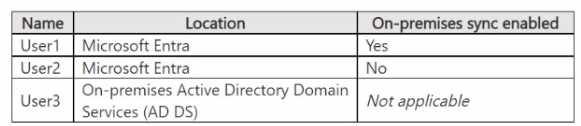 You have an Azure Virtual Desktop deployment that uses FSLogix profiles and contains the host pools shown in the following table.
  The host pools contain the session hosts shown in the following table.
 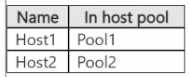 For each of the following statements, select Yes if the statement is true. Otherwise, select No. NOTE: Each correct selection is worth one point.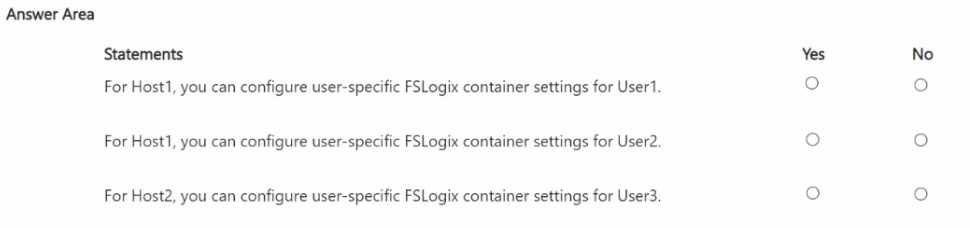
User1 is the only one explicitly assigned to an app group, so others likely have no access.
One thing I noticed is that since user1 is assigned to app group1 in host pool1, they should definitely have access to session host1 and host2. Also, user2 isn’t assigned to any app group in host pool2, so they likely can’t connect to session host3 or host4. That makes me say Yes for user1’s access and No for user2 in host pool2. The FSLogix profile setup doesn’t impact direct permissions, so focus is really on app group assignments here.
HOTSPOT - You have an Azure Virtual Desktop deployment that contains the session hosts shown in the following table.  You have the users shows in the following table.
 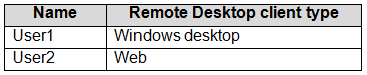 Users connect to Azure from the locations shown in the following table.
 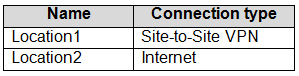 For each of the following statements, select Yes if the statement is true. Otherwise, select No. NOTE: Each correct selection is worth one point.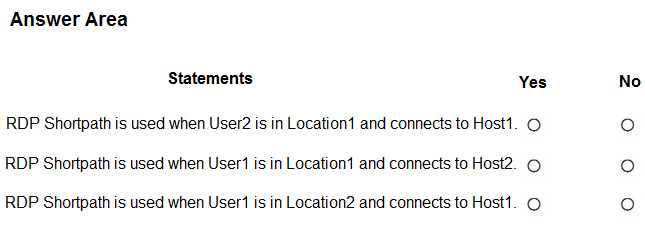
I’m thinking A should be a no because US West users connecting to US East hosts would definitely have higher latency, so it’s not ideal. Also, for C, since Asia users are closest to the Europe hosts, it might not be a perfect match but better than connecting to US hosts, so maybe yes there. The focus seems to be on minimizing latency by matching user location to session host region, so any cross-continental connections are probably marked as no. That logic helps clear up some of the answers for me.
B feels off since NA users should avoid Europe hosts due to latency issues.
HOTSPOT You have an Azure Virtual Desktop deployment. You are configuring the outbound firewall settings for the host pool. Which outbound URL and outbound port should you configure to ensure that the host machines maintain Windows activation? To answer, select the appropriate options In the answer area. NOTE: Each correct selection is worth one point. 
I’d pick port 80 since activation often uses HTTP, not always HTTPS.
I’d say activation uses port 443 since it’s a secure process, so option with 443 seems safer. Plus, activation.microsoft.com is the main URL I’ve seen mentioned for licensing checks.