Home/google/Free Google Associate-Android-Developer Actual Exam Questions
Free Google Associate-Android-Developer Actual Exam Questions
The questions for this exam were last updated on January 7, 2026
Dumps Box (DumpsBox) offers up-to-date practice exam questions for Associate-Android-Developer certification exam which are developed and validated by Google subject domain experts certified in Google Associate-Android-Developer . These practice questions are update regularly as we keep an eye on any recent changes in Associate-Android-Developer syllabus, and when there is update our team quickly adjusts the questions. This commitment to providing the best quality exam prep material to certification aspirants is what makes DumpsBox.com the best certification exam prep website. On top of that, our strong, yet strictly moderated, community based feedback keeps the content clean and current. Each question has helpful community discussion that provides it extra perspective and introduces helpful resources for better exam preparation. This also saves students from other outdated practice questions or illicit exam dumps that can have adverse affects on career. Browse through our Google Associate-Android-Developer exam questions and pass your exam on first try.
An overridden method onCreateOptionsMenu in an Activity returns boolean value. What does this value mean?
Select one option, then reveal solution.
Question No. 2
Android Tests. You can use the childSelector() method to nest multiple UiSelector instances. For example, the following code example shows how your test might specify a search to find the first ListView in the currently displayed UI, then search within that ListView to find a UI element with the text property Apps. What is the correct sample?
Select one option, then reveal solution.
Question No. 3
What is a correct part of an Implicit Intent for sharing data implementation?
Select one option, then reveal solution.
Question No. 4
As an example. Our MutableLiveData object, named mLapseTime, is not connected to a Room database, etc. How can we change the value in mLapseTime?
Select one option, then reveal solution.
Question No. 5
About queries in DAO classes. Room verifies the return value of the query such that if the name of the field in the returned object doesn't match the corresponding column names in the query response, Room alerts you in one of the following two ways: (Choose two.)
Select all that apply, then reveal solution.
Question No. 6
The following code snippet shows an example of an Espresso test:
Select one option, then reveal solution.
Question No. 7
Android Tests. You can use the childSelector() method to nest multiple UiSelector instances. For example, the following code example shows how your test might specify a search to find the first ListView in the currently displayed UI, then search within that ListView to find a UI element with the text property Apps. What is the correct sample?
Select one option, then reveal solution.
Question No. 8
“Set the activity content to an explicit view. This view is placed directly into the activity's view hierarchy. It can itself be a complex view hierarchy.” This can be done by calling method:
Select one option, then reveal solution.
Question No. 9
What method should we use with Notification.Builder to supply a PendingIntent to be sent when the notification is clicked?
Select one option, then reveal solution.
Question No. 10
For example, our preferences.xml file was added by addPreferencesFromResource (R.xml.preferences). Our preferences.xml file contains such item: In our Fragment, we can dynamically get current notification preference value in this way:
Select one option, then reveal solution.
Question No. 11
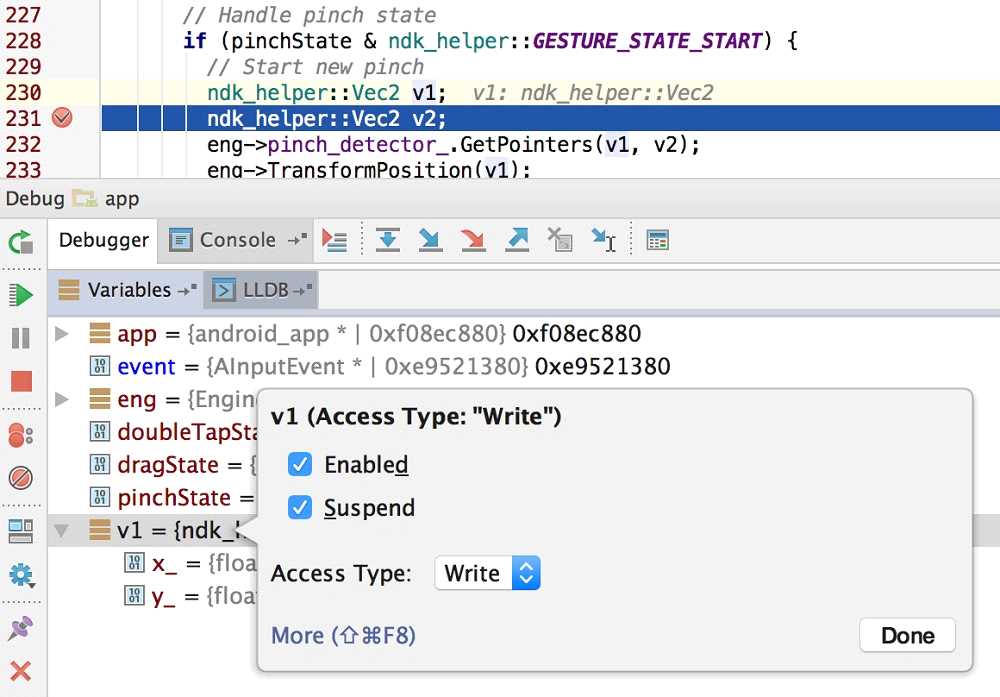
What is illustrated in the picture?
Select one option, then reveal solution.
Question No. 12
LiveData.postValue() and LiveData.setValue() methods have some differences. So if you have a following code executed in the main thread: liveData.postValue("a"); liveData.setValue("b"); What will be the correct statement?
Select one option, then reveal solution.
Question No. 13
By default, the notification's text content is truncated to fit one line. If you want your notification to be longer, for example, to create a larger text area, you can do it in this way:
Select one option, then reveal solution.
Question No. 14Drag & Drop
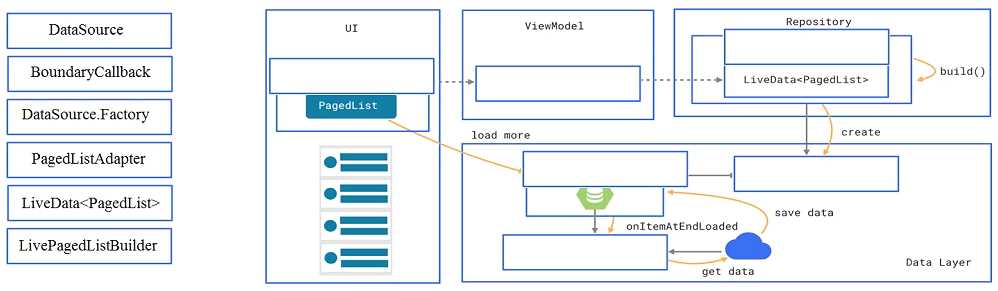
DRAG DROP In a common Paging Library architecture scheme, move instances to the correct positions.
Options
ADataSource
BBoundaryCallback
CDataSource.Factory
DPagedListAdapter
ELiveData
FLivePagedListBuilder
GDataSourceFactory
Drag an item to a target. Click × to remove.
Answer Area
UI
Drop item here
ViewModel
Drop item here
Repository
Drop item here
Load More
Drop item here
Create
Drop item here
onItemAtEndLoaded
Drop item here
Question No. 15Drag & Drop
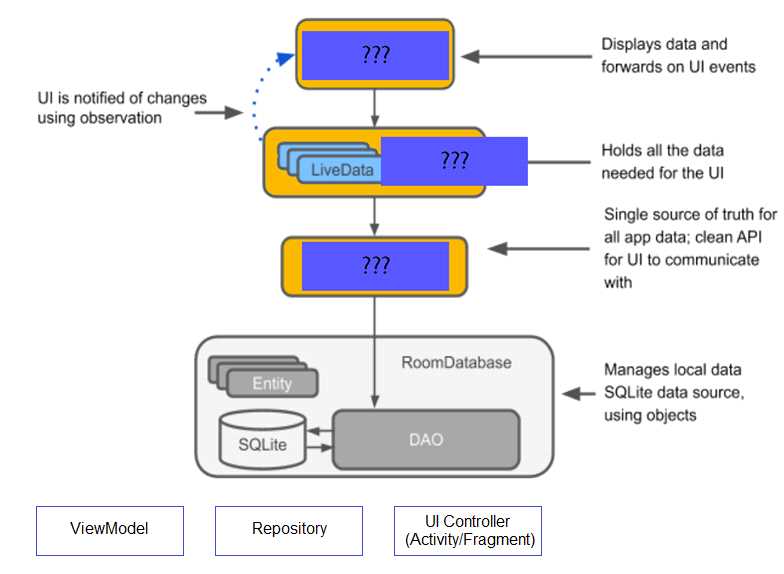
DRAG DROP The diagram below shows a basic form of the recommended architecture for apps that use Architecture Components. The architecture consists of a UI controller, a ViewModel that serves LiveData, a Repository, and a Room database. Drag modules to correct places.
Options
AViewModel
BRepository
CUl Controller (Activity/Fragment)
Drag an item to a target. Click × to remove.
Answer Area
Displays data and forwards on Ul events
Drop item here
Holds all the data needed for the Ul
Drop item here
Single source of truth for all app data; clean API for Ul to communicate with