Free Databricks Certified Data Engineer Associate Actual Exam Questions
Dumps Box (DumpsBox) offers up-to-date practice exam questions for Databricks-Certified-Data-Engineer-Associate certification exam which are developed and validated by Databricks subject domain experts certified in Databricks Certified Data Engineer Associate . These practice questions are update regularly as we keep an eye on any recent changes in Databricks-Certified-Data-Engineer-Associate syllabus, and when there is update our team quickly adjusts the questions. This commitment to providing the best quality exam prep material to certification aspirants is what makes DumpsBox.com the best certification exam prep website. On top of that, our strong, yet strictly moderated, community based feedback keeps the content clean and current. Each question has helpful community discussion that provides it extra perspective and introduces helpful resources for better exam preparation. This also saves students from other outdated practice questions or illicit exam dumps that can have adverse affects on career. Browse through our Databricks Certified Data Engineer Associate exam questions and pass your exam on first try.
the INSERT INTO command?
D makes the most sense. MERGE INTO is designed to handle situations where you want to update existing rows or insert new ones without creating duplicates. INSERT INTO just adds rows blindly and doesn’t check for duplicates. Options like A and C don’t really relate to MERGE’s purpose, and B/E are about table types that might not support MERGE at all. So, avoiding duplicate records in the target table fits best with MERGE INTO.
D/B? MERGE INTO is great for updates or avoiding duplicates, but it only works if the target table supports those operations—usually a Delta table, not external ones. That rules out B mostly, so D fits best.
Guessing D, since Gold tables feed dashboards directly with aggregated data.
Gold tables are usually the end source, so D fits best here.
but the engineer has not provided any type inference or schema hints in their pipeline. Upon
reviewing the data, the data engineer has noticed that all of the columns in the target table are of
the string type despite some of the fields only including float or boolean values.
Which of the following describes why Auto Loader inferred all of the columns to be of the string
type?
Makes sense that a type mismatch across files would force Auto Loader to default to string, so A.
A/B? If there was a type mismatch (A), Auto Loader might fallback to string to avoid errors. But B also fits since JSON is text and no schema hints usually means defaulting to strings.
It’s B and E. Unity Catalog manages metadata, so it’s control plane, and Compute Orchestration handles resource management, which fits control plane tasks better than the actual compute options.
B E. I agree that Unity Catalog is definitely part of the control plane since it manages governance and metadata. Compute Orchestration fits because it handles the coordination and deployment of resources, which aligns with control plane duties. The other options like Virtual Machines and Serverless Compute tend to focus more on the data plane or runtime environment. So B and E seem like the best fit here based on what control plane usually covers.
than 25 from the existing Delta table my_table and save the updated table?
D imo, UPDATE won’t delete rows, just change their values, so B and D can be dropped. A is just a SELECT, no deletion happens. Between C and E, E deletes rows where age <= 25, which is opposite of what we want. So C is the only option that directly removes rows where age > 25. The syntax looks standard for DELETE in SQL-based systems like Delta Lake, so it should work here to update the table as asked.
C/E? C deletes rows where age > 25, which matches the requirement. E deletes the opposite set (age <= 25), so it’s not right. Also, UPDATE statements (B and D) won’t remove rows, just modify them. A is just selecting data, no deletion. So between C and E, only C fits the need to remove rows with age over 25.
composable table:
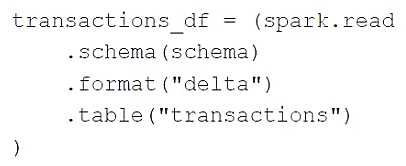
Which of the following changes needs to be made so this code block will work when the transactions
table is a stream source?
Also thinking E makes the most sense because streaming requires a different reader method. Options like B or D don’t actually switch from batch to streaming, so they seem off here. Does anyone see a scenario where C would matter?
Maybe E, since switching to streaming usually means using spark.readStream instead of spark.read. The other options don’t really enable streaming directly.
tables is always true?
E imo, Silver tables usually hold filtered or summarized data, so they often have less volume than Bronze, which is raw data. That makes E a solid candidate since data size typically decreases after cleaning.
Maybe D is the best fit here since Bronze tables are typically the raw, unprocessed data layer, and Silver tables are where cleansing and transformations happen. That means Silver should always be cleaner or more refined. A and C don’t make much sense because Bronze is usually the source of raw data, so it can’t be less refined or smaller in volume than Silver all the time. E might be true in some cases but not guaranteed, especially if Silver includes extra columns or enriched data. So D feels like the safest bet for something that’s always true.
data engineering team’s reports. The leader believes the siloed nature of their organization’s data
engineering and data analysis architectures is to blame.
Which of the following describes how a data lakehouse could alleviate this issue?
B/C? Having one source of truth (B) definitely helps, but if teams reorganize under one department (C), that might improve communication and reduce silos too. Still, B feels more direct for the data consistency issue.
I agree that having a single source of truth (B) is crucial here. Without consistent data inputs, autoscaling (A) or faster responses (E) won’t fix the core mismatch in reports. Could the problem really be solved without unified data access?
A sounds off since array functions focus on arrays specifically, not multiple data types at once. D still fits better if we think about JSON’s nested arrays, right? Could the question be hinting at something else though?
Probably D. Array functions are designed to manipulate nested data types like arrays, which are common in JSON files, so they fit best with complex, nested data handling.
It’s A because cluster pools help distribute computing resources, which speeds up report refresh times, especially when you need quick turnaround on automated reports. E seems less about speed and more about access.
D imo, version control is about managing changes, not resource sharing like cluster pools.
team will need full privileges on the table sales to fully manage the project.
Which command can be used to grant full permissions on the database to the new data engineering
team?
D imo, the syntax is off there—it’s granting privileges on “team” to “sales,” which doesn’t make sense. A is more straightforward and fits standard SQL for giving full control on a table. B is clearly not enough since just SELECT won’t let them manage or modify anything. C tries to list specific permissions but isn’t valid syntax in most SQL dialects. So, A seems like the best fit assuming “team” is the user or role name here.
It’s A for me too. B is way too limited since just SELECT won’t let the team manage the table. C isn’t even valid syntax as far as I know, and D mixes up the objects—it grants privileges on the team to sales, which makes no sense. So A is the only option that properly gives full permissions on the sales table to the team.
They can ask the table owner for permission, but they do not know who the table owner is.
Which approach can be used to identify the owner of new_table?
D. The Owner field in Data Explorer is usually the go-to for this info, even if you don’t have full rights yet. Other options don’t typically show owner details directly.
Option C, since permissions often list owners and admins directly.
Maybe D here. The data is definitely stored in the customer’s cloud because it’s their actual files and information. Options like notebooks or repos are more managed by Databricks itself or synced, but not the primary storage. Cluster management metadata feels more like something handled by Databricks’ control plane rather than stored inside the customer’s cloud environment. So, data is the safest bet for what’s actually kept in the customer’s cloud account.
D/B? Data (D) has to be in the customer's cloud for security. Cluster management metadata (B) might also be stored there since it relates directly to running the clusters on customer resources.
INCREMENTAL LIVE TABLE) syntax over the CREATE LIVE TABLE syntax when creating Delta Live Tables
(DLT) tables using SQL?
It’s B because streaming implies handling data as it arrives, so incremental fits best.
It’s B because streaming tables are meant for incremental data processing, unlike CREATE LIVE TABLE which is more for batch or static data. The focus is definitely on handling new data continuously.
Maybe E, but also thinking about D. You definitely need to tell the pipeline where to put the output data, so specifying a target database location seems necessary. Without that, the pipeline wouldn't know where to write results. A and B feel optional for tuning, and C sounds more like staging data rather than final output. So E for logic makes sense, but D might be just as crucial for the pipeline to function properly.
It’s E because you can’t build a pipeline without specifying the notebook with your logic.