Free Top CompTIA Pentest+ PT0-003 Actual Exam Questions
Dumps Box (DumpsBox) offers up-to-date practice exam questions for PT0-003 certification exam which are developed and validated by CompTIA subject domain experts certified in Top CompTIA Pentest+ PT0-003 . These practice questions are update regularly as we keep an eye on any recent changes in PT0-003 syllabus, and when there is update our team quickly adjusts the questions. This commitment to providing the best quality exam prep material to certification aspirants is what makes DumpsBox.com the best certification exam prep website. On top of that, our strong, yet strictly moderated, community based feedback keeps the content clean and current. Each question has helpful community discussion that provides it extra perspective and introduces helpful resources for better exam preparation. This also saves students from other outdated practice questions or illicit exam dumps that can have adverse affects on career. Browse through our Top CompTIA Pentest+ PT0-003 exam questions and pass your exam on first try.
[Attacks and Exploits] A penetration tester is trying to get unauthorized access to a web application and executes the following command:
GET /foo/images/file?id=2e%2e%2f%2e%2e%2f%2e%2e%2f%2e%2e%2fetc%2fpasswd
Which of the following web application attacks is the tester performing?
It’s C for sure. The encoded ../ patterns clearly show an attempt to break out of a restricted folder and access a sensitive file, which perfectly matches directory traversal.
Option C stands out here because the attacker uses encoded ../ sequences to climb out of the allowed directory and access /etc/passwd, which is a classic directory traversal move. The key point is they’re trying to read a system file by tricking the path resolution, not necessarily including that file in a script or exploiting a reference flaw. So it fits directory traversal more than local file inclusion or other options.
During an internal penetration test, a tester compromises a Windows OS-based endpoint and
bypasses the defensive mechanisms. The tester also discovers that the endpoint is part of an Active
Directory (AD) local domain.
The tester’s main goal is to leverage credentials to authenticate into other systems within the Active
Directory environment.
Which of the following steps should the tester take to complete the goal?
It’s A because the main goal is to get credentials for other systems, and Mimikatz directly pulls those from memory. B and D don’t really help with AD-wide access, and C depends on already having creds.
It’s A. Mimikatz is really the standard tool for extracting credentials directly from memory on a compromised Windows endpoint, which fits perfectly with the goal of moving laterally in an AD environment. B doesn’t work as well here since cracking local passwords isn’t necessary if you can grab creds directly. C depends on having valid creds first, which Mimikatz helps get. D is more about initial exploitation, not lateral movement using existing credentials. So, using Mimikatz to get those account details is the most straightforward way to achieve the tester's objective.
[Attacks and Exploits] During an assessment, a penetration tester gains a low-privilege shell and then runs the following command:
findstr /SIM /C:"pass" *.txt *.cfg *.xml
Which of the following is the penetration tester trying to enumerate?
Option D. The command is searching for "pass" across config and text files, aiming to find secret data like passwords, not just the files themselves or permissions.
Makes sense, they want to find any secrets containing “pass,” so D.
communications. During which of the following activities should the penetration tester discuss this
issue with the client?
Maybe D fits best here since the WAF issue impacts multiple stakeholders, not just the tester or one team. Getting everyone on the same page can help decide the next steps properly.
I’m thinking client acceptance (C) might be important here since that’s when you confirm the test scope and any known blockers like a WAF. Shouldn't this be cleared before testing starts?
Which of the following techniques is the best way to avoid detection by data loss prevention tools?
A Encoding can be easily detected since most DLP tools recognize common encoding schemes. It’s probably not the best choice compared to encryption or compression which hide data better.
Maybe B works too since compression can hide patterns better than simple encoding, making it harder for DLP to spot sensitive data unless it decompresses first. Encryption’s still strong but depends on tool capabilities.
A penetration tester finishes a security scan and uncovers numerous vulnerabilities on several hosts.
Based on the targets' EPSS (Exploit Prediction Scoring System) and CVSS (Common Vulnerability
Scoring System) scores, which of the following targets is the most likely to get attacked?
A/D? A has the highest EPSS, meaning attackers are more likely to try it, but D’s CVSS is higher, so the impact is worse if exploited. Attackers might prefer A for ease or D for damage.
Option D seems better because even though its EPSS score is lower than A’s, the CVSS score is higher, meaning the vulnerability is more severe. Attackers usually aim for vulnerabilities that are both likely to be exploited and have a high impact. So, having a higher CVSS with a decent EPSS might make Target 4 more attractive than Target 1.
[Attacks and Exploits] A penetration tester finds that an application responds with the contents of the /etc/passwd file when the following payload is sent:
xml Copy code ]> &foo;
Which of the following should the tester recommend in the report to best prevent this type of vulnerability?
A vs C? While disabling external entities (C) is ideal to stop this vulnerability directly, sometimes apps absolutely need them for legit reasons. In those cases, just locking down file permissions (A) doesn’t stop the XML parser from reading sensitive files if it still processes external entities. So A alone isn’t really enough. If you can’t disable external entities, then more controls like WAF or patching the parser are necessary, but from the options given, C is usually the best recommendation if feasible.
C/D? I get why disabling external entities (C) is the solid fix since it cuts off the exploit at its root. But if the app depends on XML features that break when you disable those entities, a WAF (D) could act as a good safety net to catch these attacks before they hit the app. So, if disabling isn’t an option right away, D might be the practical next step. A and B don’t really address the core issue here.
A penetration tester is performing an authorized physical assessment. During the test, the tester
observes an access control vestibule and on-site security guards near the entry door in the lobby.
Which of the following is the best attack plan for the tester to use in order to gain access to the
facility?
It’s A because if the tester can clone badge info found in public areas, they might bypass guards and vestibule controls without needing to physically tailgate or pick locks, which are much riskier.
B imo, tailgating is usually the easiest way around physical security if guards are around but busy. Cloning badges or lock picking seems way riskier without more info on electronic access controls.
A penetration tester is ready to add shellcode for a specific remote executable exploit. The tester is
trying to prevent the payload from being blocked by antimalware that is running on the target.
Which of the following commands should the tester use to obtain shell access?
D is clearly off since it’s not generating a valid shellcode payload at all. Between A, B, and C, what stands out is encoding for AV evasion. B uses Meterpreter reverse shell, which is powerful but doesn’t mention encoders. C’s just a reverse shell without encoding. So A fits the question best since shikata_ga_nai is designed to obfuscate payloads to bypass antimalware detection, making it the better choice for that specific need.
Good point about the encoder in option A—it’s built specifically for evading AV detection by obfuscating the payload. B and C are solid reverse shells but don’t mention encoding or obfuscation, which is key when antimalware is involved. D is definitely off-topic anyway. So I’d say A fits best since it combines the right architecture, platform, and a well-known encoder designed for stealth against antimalware.
During an assessment, a penetration tester sends the following request:
POST /services/v1/users/create HTTP/1.1
Host: target-application.com Content-Type:
application/json Content-Length: [dynamic]
Authorization: Bearer (FUZZ)
Which of the following attacks is the penetration tester performing?
B/D? The request targets an API endpoint with a fuzzed token, which fits API abuse. But if the tester aims to exploit token weaknesses to gain higher access, it edges toward privilege escalation.
B fuzzing the Authorization header is classic API abuse, trying to find weak tokens or bypass controls. It’s not about server-side request forgery or directory traversal since the path is straightforward.
HOTSPOT [Information Gathering and Vulnerability Scanning] A penetration tester is performing reconnaissance for a web application assessment. Upon investigation, the tester reviews the robots.txt file for items of interest. INSTRUCTIONS Select the tool the penetration tester should use for further investigation. Select the two entries in the robots.txt file that the penetration tester should recommend for removal. 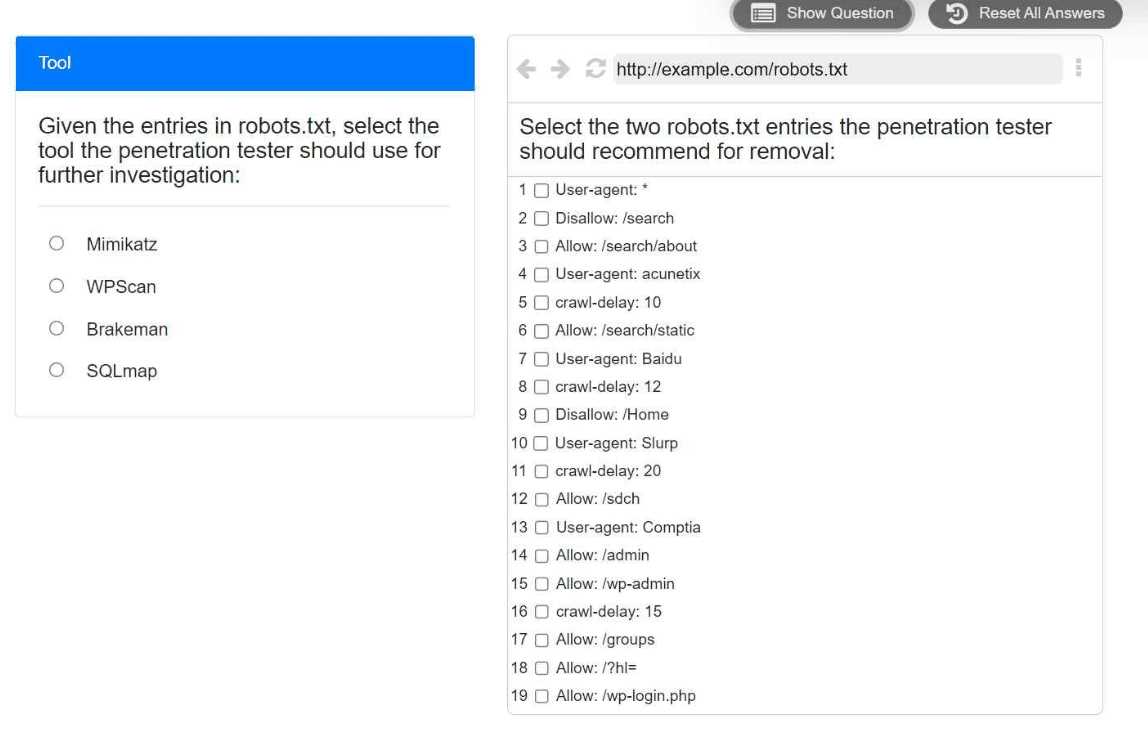
C for tool; definitely remove /admin and /secret since they’re sensitive directories.
Tool C seems better since it’s known for crawling and analyzing robots.txt directly. Definitely recommend removing /admin and /secret since those leak sensitive areas that attackers could target.
[Attacks and Exploits] A previous penetration test report identified a host with vulnerabilities that was successfully exploited. Management has requested that an internal member of the security team reassess the host to determine if the vulnerability still exists. 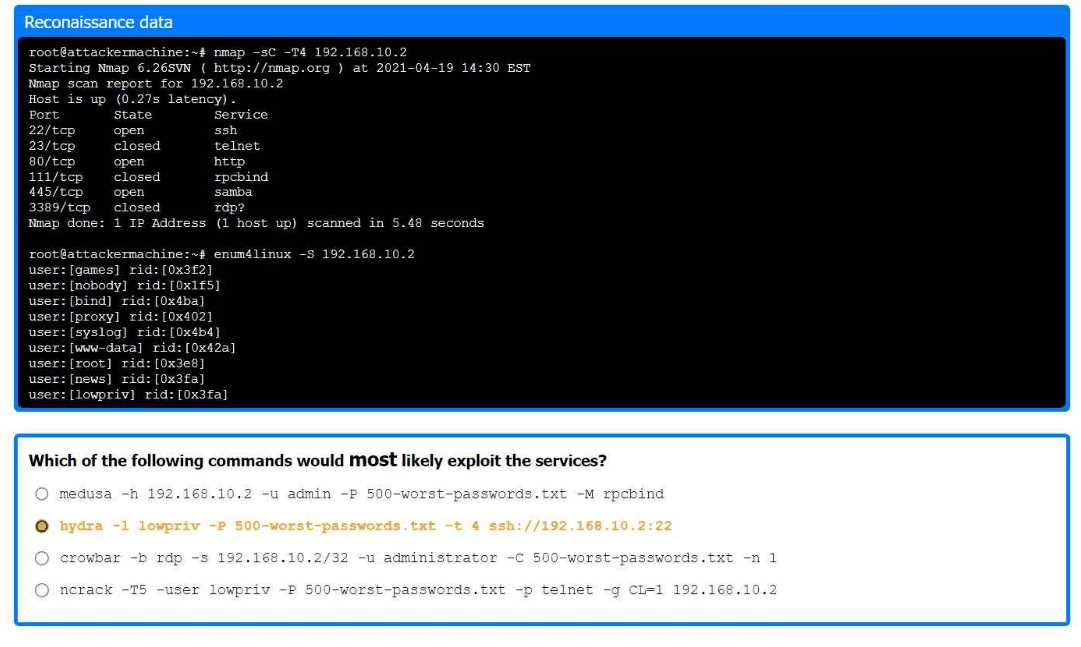 Part 1: . Analyze the output and select the command to exploit the vulnerable service. Part 2: . Analyze the output from each command. · Select the appropriate set of commands to escalate privileges. · Identify which remediation steps should be taken.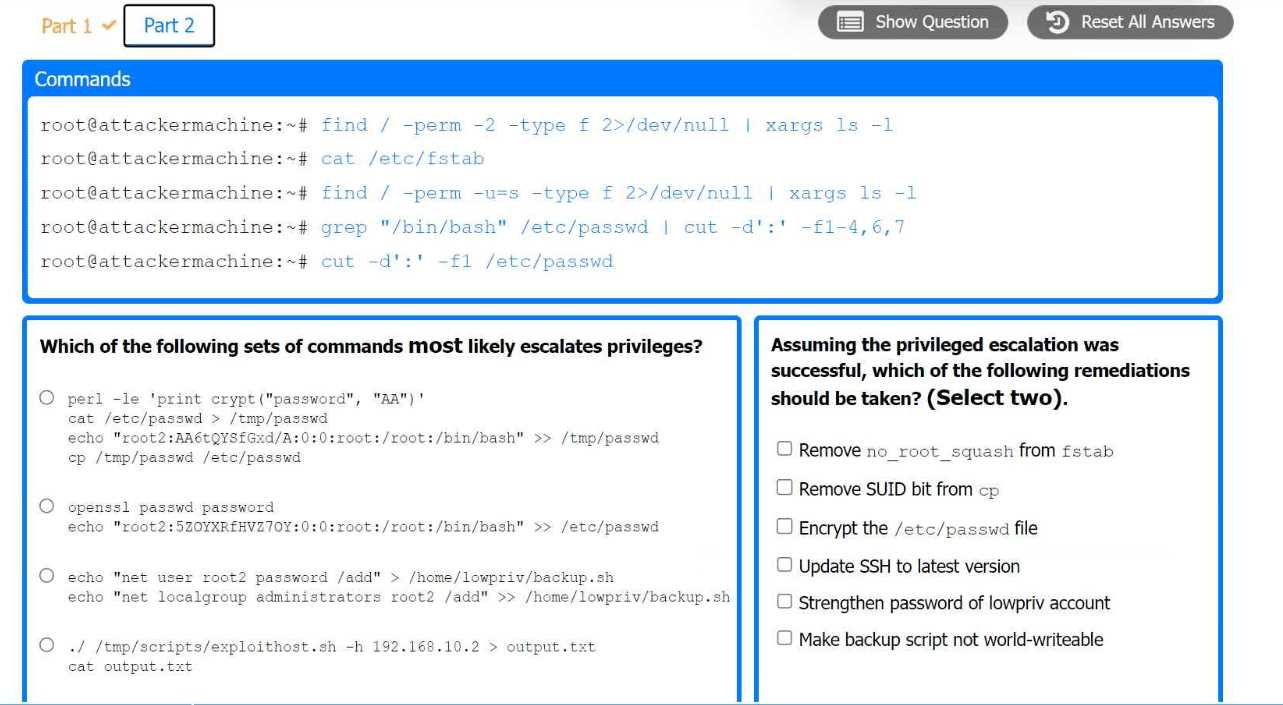
For Part 1, the exploit targets the specific vulnerable version shown, so that fits. For Part 2, since the sudo output lists commands allowed without a password, those commands are your best bet for escalation—no need to try unrelated binaries.
Part 1’s command fits the service version; Part 2 should focus on sudo permissions shown.
HOTSPOT -You are a security analyst tasked with hardening a web server. You have been given a list of HTTP payloads that were flagged as malicious.
INSTRUCTION - Giving the following attack signatures, determine the attack type, and then identify the associated remediation to prevent the attack in the future. If at any time you would like to bring back the initial state of the simulation, please click the Reset All button. Hot Area:
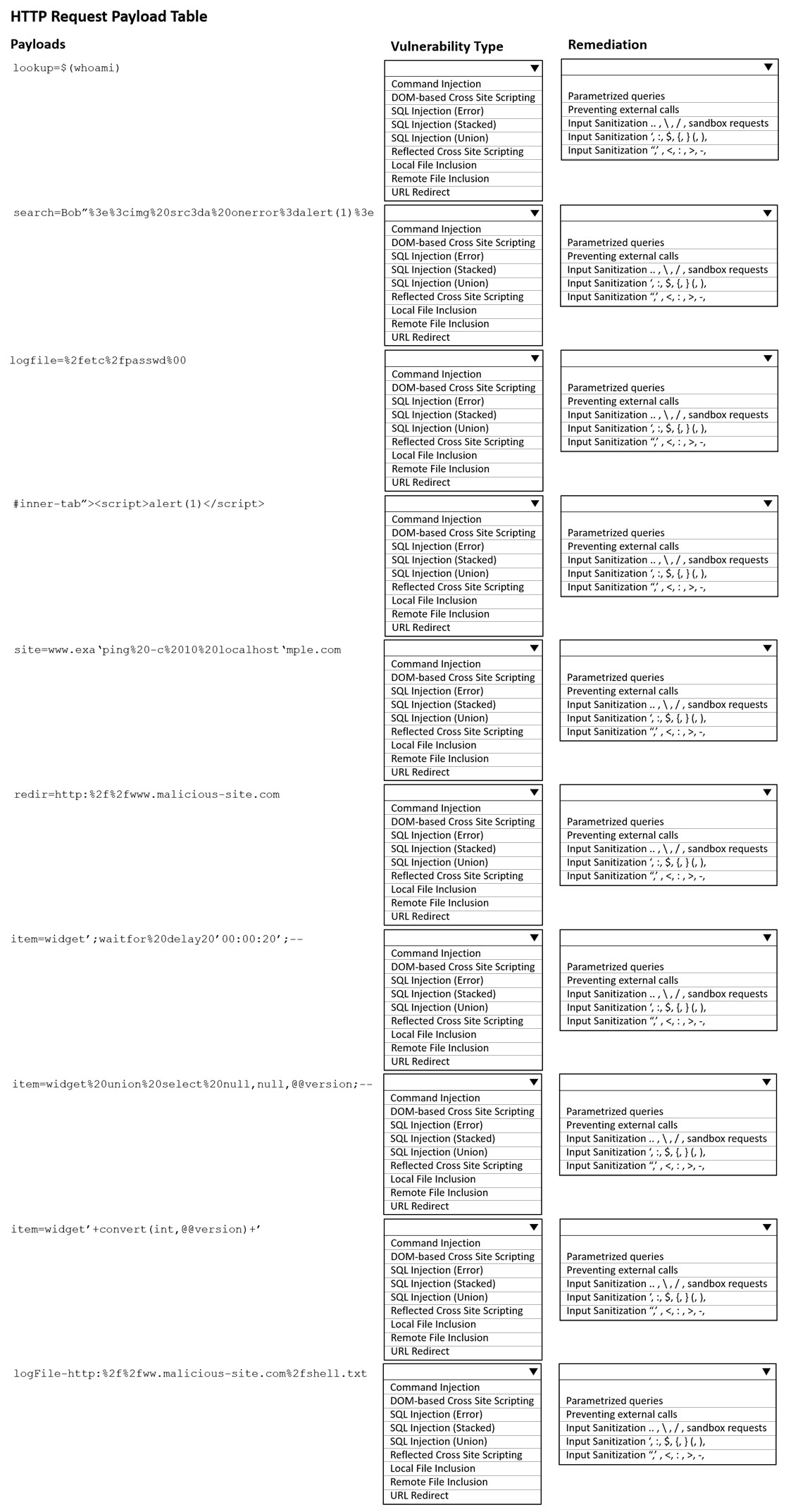
Looks like the payloads clearly show classic SQL injection patterns, so focusing on input validation and prepared statements is key. Option C seems right since it mentions parameterized queries, which block injections effectively.
B looks like cross-site scripting since it has script tags. The fix should be output encoding or input validation instead of SQL-focused options.
[Attacks and Exploits] You are a penetration tester running port scans on a server. INSTRUCTIONS Part 1: Given the output, construct the command that was used to generate this output from the available options. Part 2: Once the command is appropriately constructed, use the given output to identify the potential attack vectors that should be investigated further. If at any time you would like to bring back the initial state of the simulation, please click the Reset All button. 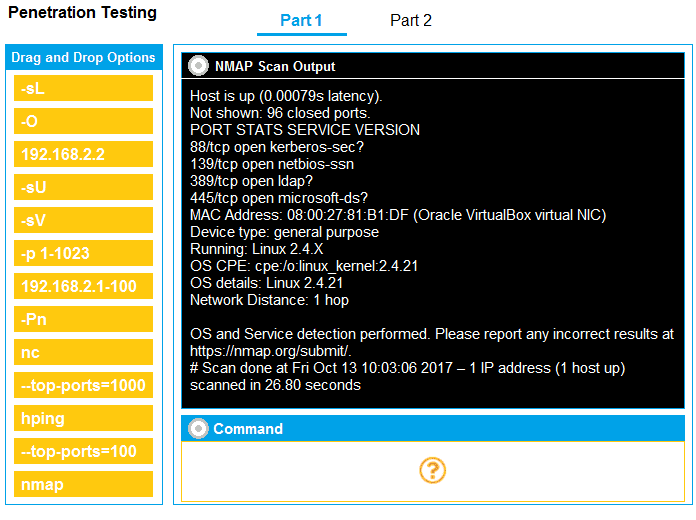
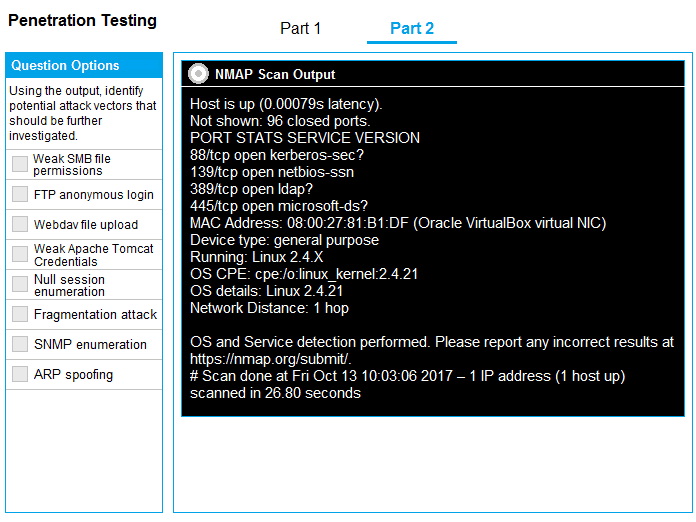
I agree option C fits well for the SYN scan, but also consider why ports 22 and 80 are open—SSH could be vulnerable to brute force or outdated ciphers, HTTP might have web app flaws. Another angle is to check for default or weak credentials since those services often get exploited that way. Even if it’s a stealth scan, the attacker’s probing those specific services for a reason, so focusing on them makes sense for follow-up testing.
Option C for the command, and look into open SSH and HTTP ports.
SIMULATION
-
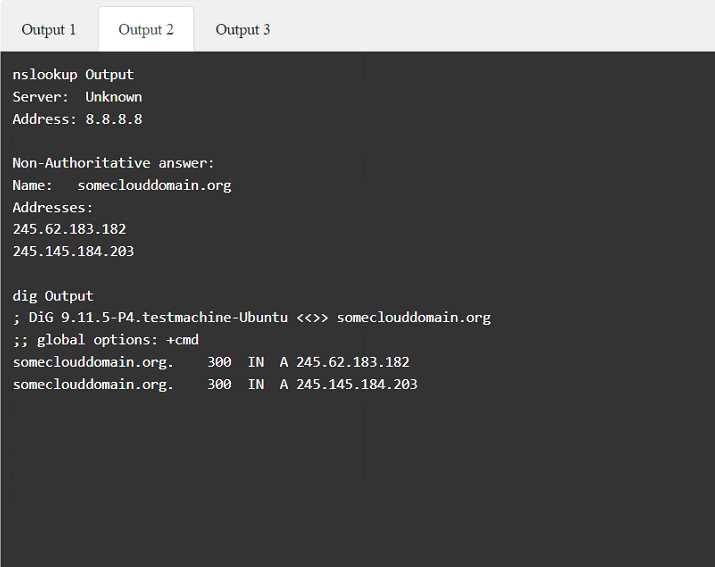
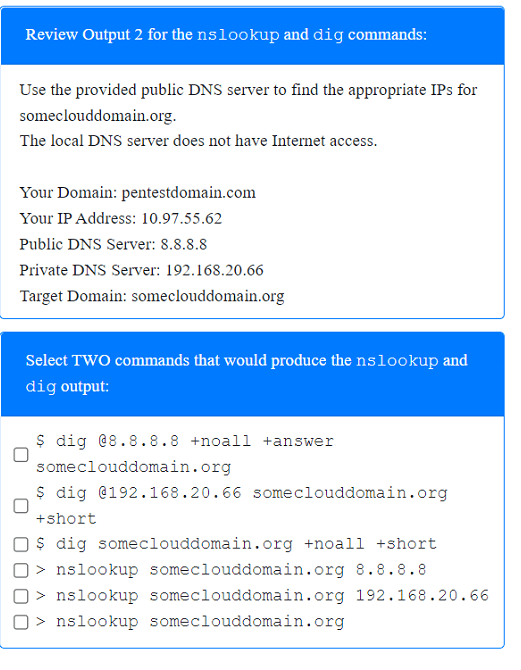
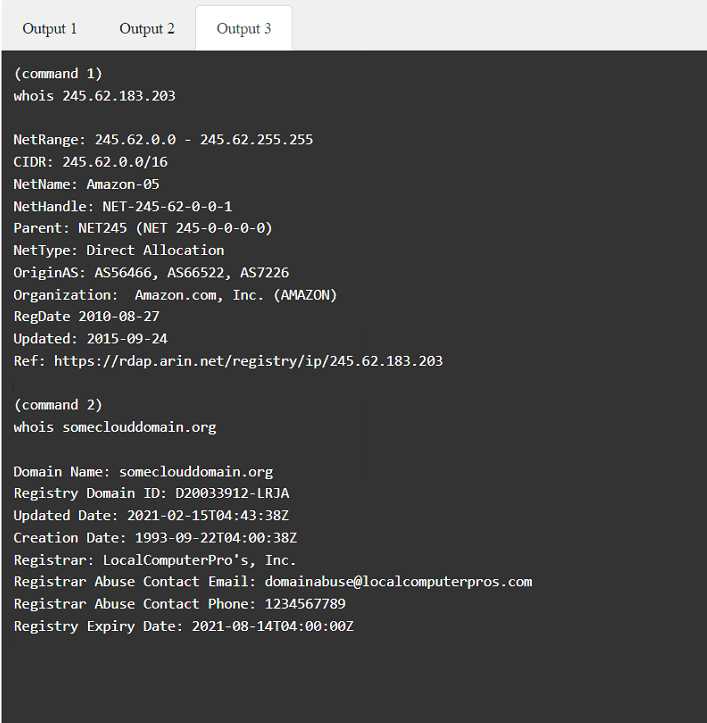
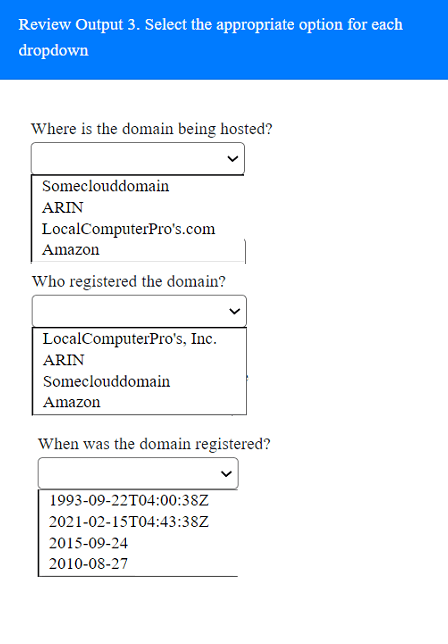
A penetration tester has been provided with only the public domain name and must enumerate additional information for the public-facing assets.
INSTRUCTIONS
-
Select the appropriate answer(s), given the output from each section.
If at any time you would like to bring back the initial state of the simulation, please click the Reset All button. 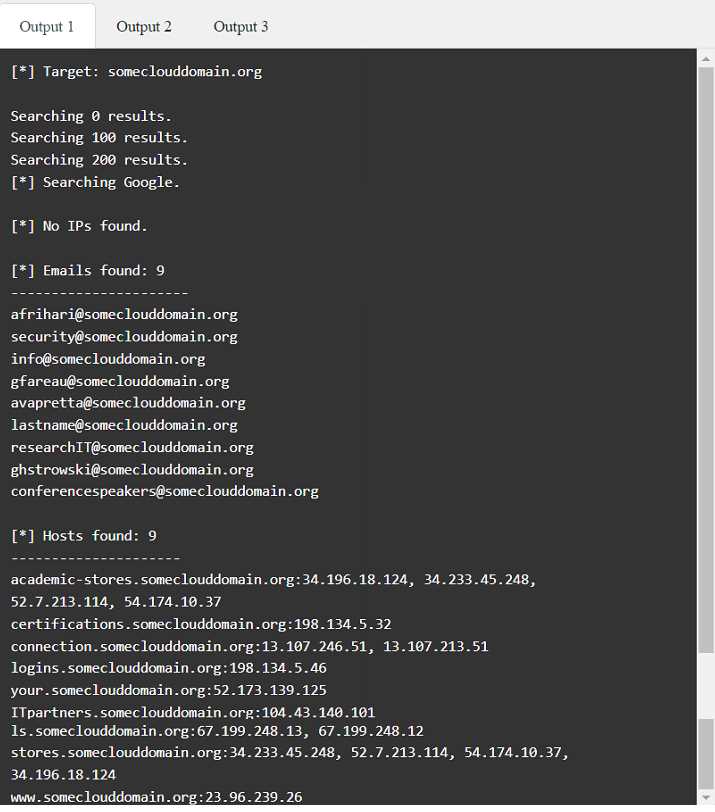
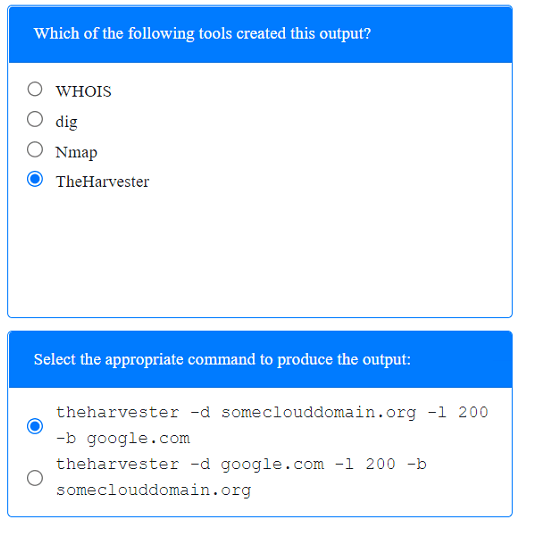
Option D shows actual web services running, making it more useful than just DNS entries.
Option C confirms live services on specific ports, more reliable than DNS lists.