Free Cisco 300-620 Actual Exam Questions - Question 15 Discussion
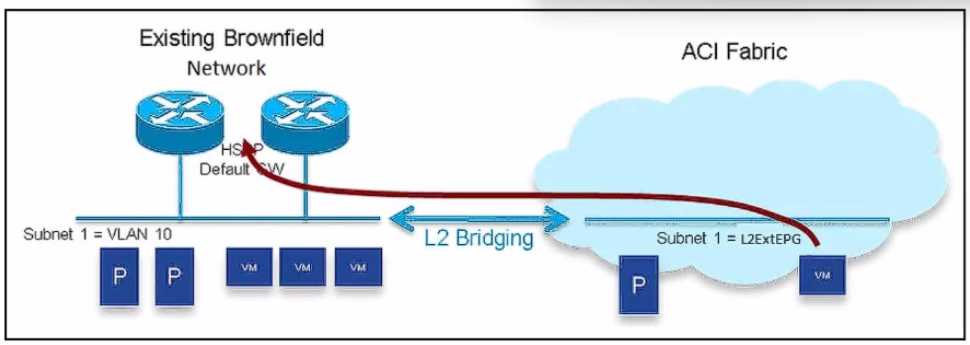
An engineer must migrate workloads from the brownfield network to the Cisco ACI fabric. The VLAN
10 default gateway remains in the router located in the brownfield Network. The bridge domain has
already been associated with L20ut. Which two actions must be taken to migrate the workloads?
(Choose two.)
Maybe D and E since ARP flooding helps with gateway traffic inside the fabric.
It’s D and C for me. Mapping the MAC of the default gateway to the bridge domain (D) is crucial since the gateway stays in the brownfield network, so traffic knows where to go. For the second one, setting L2 Unknown Unicast Flood (C) makes sense because without it, unknown traffic from the brownfield side might get dropped inside the fabric. This helps ensure devices can still communicate properly during migration. A feels more about IP learning specifics, but flooding unknown unicast ensures seamless traffic flow during this transition phase.
D imo, mapping the MAC to the bridge domain is key to direct traffic properly. Also, A makes sense since limiting IP learning to subnet avoids confusion with MAC addresses learned outside the fabric.
It’s B and D for me. Since the default gateway stays in the brownfield router, enabling multi-destination flooding in the encapsulation (B) helps ensure broadcast and unknown traffic reaches the old gateway. Mapping the MAC of that gateway to the bridge domain (D) is crucial so the fabric can forward traffic correctly without relying on unknown unicast floods. A and E don’t address the need for explicit gateway MAC mapping or multi-destination flooding, which are key here.
It’s A and E for me. Since the default gateway stays in the brownfield router, limiting IP learning to subnet (A) helps avoid MAC learning issues inside the fabric. Also, enabling ARP flooding (E) ensures that all hosts can resolve the gateway’s MAC when it’s outside the fabric, which is crucial for smooth communication. Options like D seem useful, but mapping the gateway MAC isn’t strictly necessary if ARP flooding is on. B and C mostly deal with unknown unicast and multicast flooding, which don’t address the gateway being external as directly as A and E do.
C/D? Since the gateway stays outside, unknown unicast flooding (C) helps traffic reach it, and mapping the gateway’s MAC (D) makes sure the fabric knows where to send packets without looping.
B/D? Flooding encapsulated packets might be needed for external gateway reachability, and mapping the gateway MAC could help bridge domain forwarding. Seems more direct for migration than just flooding controls.
C seems right because if the default gateway is outside the fabric, unknown unicast traffic needs to flood to reach it. E also fits since ARP flooding will help the hosts discover the gateway’s MAC address more easily. Options like B or D feel less relevant since multi-destination flooding or mapping the gateway MAC directly aren’t typical steps for this kind of migration. The key is ensuring traffic, especially ARP and unknown unicast, can get out to the brownfield router acting as the gateway without being dropped inside the fabric.
B/D? I’m thinking B because setting multi-destination flooding to flood in encapsulation might be necessary to handle unknown traffic properly when the gateway is outside the fabric. D makes sense too since mapping the MAC of the default gateway to the bridge domain would help direct traffic correctly. C and E are about flooding, which could be helpful but might cause unnecessary noise if not configured carefully. A seems more about IP learning control rather than handling external gateways. So B and D seem more aligned with making sure traffic reaches and is recognized by the brownfield route
Option C and E seem like the better picks here. Since the default gateway is still outside the ACI fabric, enabling L2 Unknown Unicast Flood (C) makes sense to ensure traffic reaches that gateway without issues. Also, enabling ARP flooding (E) will help with address resolution across the bridge domain, especially when devices are moving into the new fabric but rely on the router for gateway functions. Options like mapping MAC addresses or limiting IP learning feel less relevant given the scenario.
This one felt pretty straightforward since the default gateway stays on the brownfield router. I'd go with A and E here. Limiting IP learning to the subnet helps control MAC learning properly, and enabling ARP flooding is necessary so hosts get the gateway’s MAC. Seems like those two are key for a smooth migration without losing connectivity.