Free Cisco 300-435 Actual Exam Questions
Dumps Box (DumpsBox) offers up-to-date practice exam questions for 300-435 certification exam which are developed and validated by Cisco subject domain experts certified in Cisco 300-435 . These practice questions are update regularly as we keep an eye on any recent changes in 300-435 syllabus, and when there is update our team quickly adjusts the questions. This commitment to providing the best quality exam prep material to certification aspirants is what makes DumpsBox.com the best certification exam prep website. On top of that, our strong, yet strictly moderated, community based feedback keeps the content clean and current. Each question has helpful community discussion that provides it extra perspective and introduces helpful resources for better exam preparation. This also saves students from other outdated practice questions or illicit exam dumps that can have adverse affects on career. Browse through our Cisco 300-435 exam questions and pass your exam on first try.
Probably D, since native models are vendor-specific and tied to platform features.
This one’s tricky, but I’d say D makes the most sense too. Native models are vendor-specific and focus on platform-specific features, which matches option D. A sounds like it’s describing OpenConfig or standards-based models, not native vendor ones. B and C don’t seem quite right since native models aren’t usually from individual devs or meant to be universal like OpenConfig. So D fits best with the idea that native models are tied to their own hardware features, unlike OpenConfig that tries to be platform-agnostic.
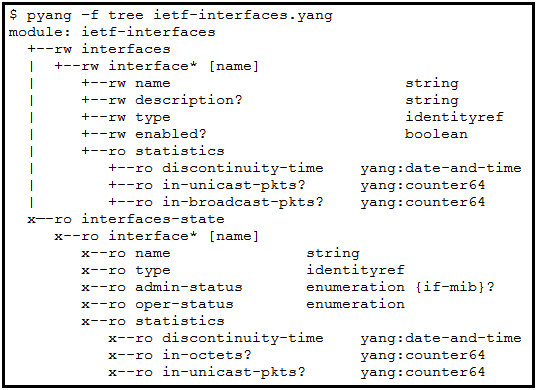
Refer to the exhibit. Drag and drop the code from the bottom onto the box where the code is missing
to complete the ncclient request that captures the operational data of the interfaces of a Cisco IOS XE
device. Options may be used once, more than once, or not at all.
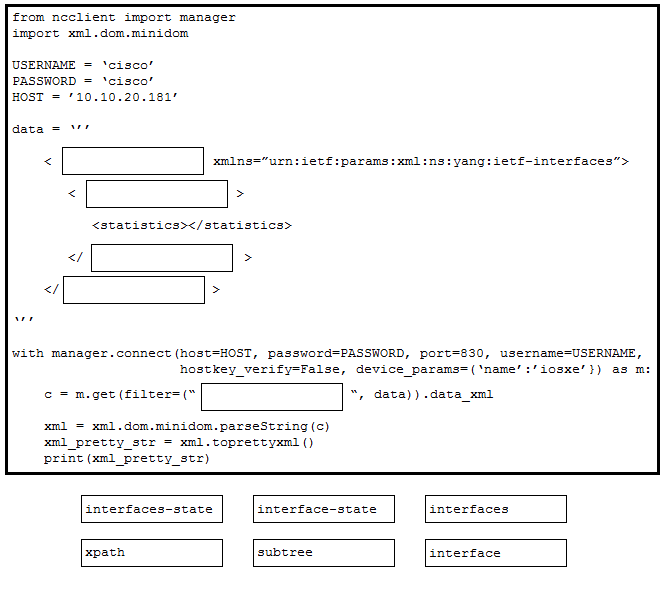
I’m thinking option A could be right because it matches the standard XML structure for interface data in NETCONF. It also fits well with the rest of the filter shown, so it completes the request logically.
I’m backing option D because it specifically mentions "interfaces-state," which directly relates to operational data. The namespace used in D matches the common pattern for state data in IOS XE, so it feels like the most precise choice. Options like B mention interfaces but seem broader, possibly pulling config rather than live state data, which might not be what the question asks for. The explicit focus on operational info in D makes it stand out for this scenario.
DHCP and TFTP?
A imo, PnP is mostly about plug and play hardware detection rather than full device config automation using DHCP and TFTP. ZTP is made for that zero-touch initial setup specifically. So while PnP might seem close, it’s not really used for the exact process described here. That makes D the better fit overall.
This one’s all about D, ZTP.
using
the Python library Requests?
Maybe C here too. PUT is generally used for replacing resources fully, which fits “replace device configuration” better than POST or PATCH. DELETE obviously won’t replace anything.
Probably C, put() is the standard for full replacement in RESTful APIs.
Drag and drop the code from the bottom onto the box where the code is missing to perform the login
operation and security check on the vManage web server at the specified IP address. Not all code
options are used.
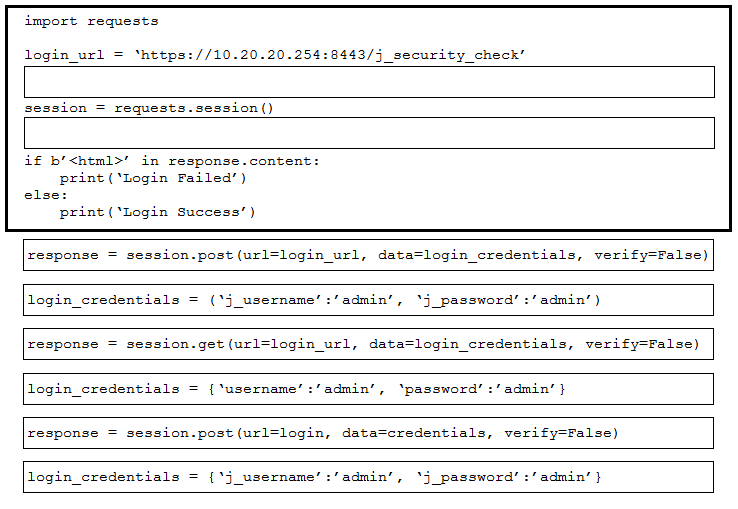
I agree that option C looks like the right pick for login because it sets up the session cookie properly, which is crucial for vManage. For the security check, I’m thinking option D might be better since it seems to validate the session without requiring an extra token. The others either look incomplete or like they’re focused more on token-based auth, which isn’t mentioned explicitly. So, C for login and D for security check feels like the cleanest fit here.
The login needs a session setup, so option C for login and maybe A for security?
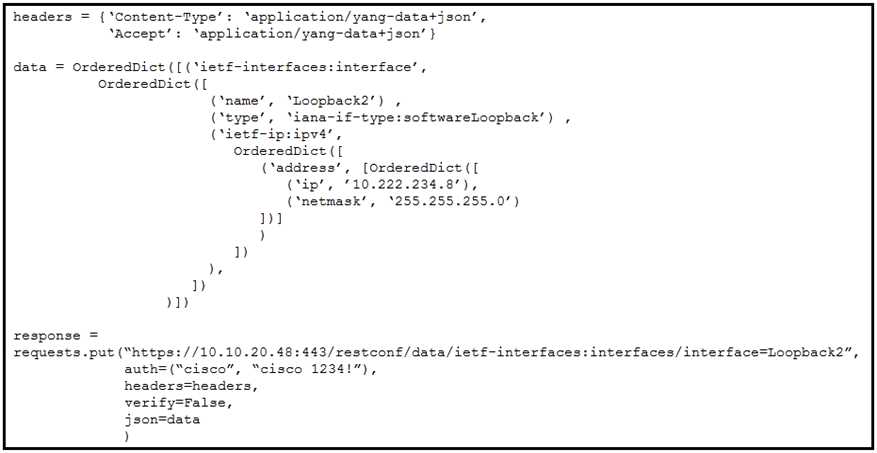
Refer to the exhibit. A Python script is used to configure a Cisco IOS XE router. The Loopback2
interface
currently
has
a
description
of Management2
and
an
IP
address/netmask
of
10.222.34.22/32. What is the result of executing the script?
It’s D. The script uses "no description," which is the correct way to remove an interface description in IOS XE. Since there’s no command to shut down or remove the interface itself, the loopback stays up with its IP address intact, but the description gets cleared. B can be ruled out because the commands are valid and should apply without rejecting the whole config. A is unlikely since the description command explicitly gets removed. C can’t happen without a "no interface" command, which isn’t shown here.
D, looks like it clears the description but keeps the interface up.
I agree with the isolation part in D, but just to add, virtual environments don't really help with running on different OS (C) or concurrency (B). So D seems the only one that fits the main purpose. Thoughts on that?
Probably D, since virtual environments keep dependencies separate for each project.
Drag and drop the code snippers from the bottom onto the blanks in the code to subscribe to a Cisco
DNA event by using the intent API . Not all options used.
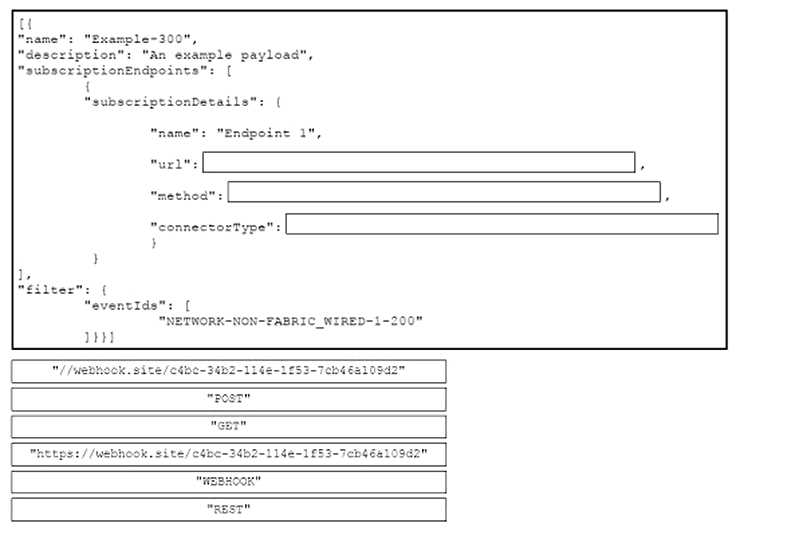
I think option B fits best for the event type since it looks like a proper string literal, which fits the typical subscribe method pattern. Also, the snippet that accepts one parameter inside the callback seems like the right choice because usually these listeners handle one event object, not multiple parameters. The others either don’t have quotes or look like unrelated code blocks, so they can be ruled out. The question is definitely about subscribing to a single event with a callback handling the event object.
The snippet with the subscribe call should include the event type string inside quotes, probably something like "DeviceAdded". Also, the callback function needs to accept an event parameter to handle the event data properly.
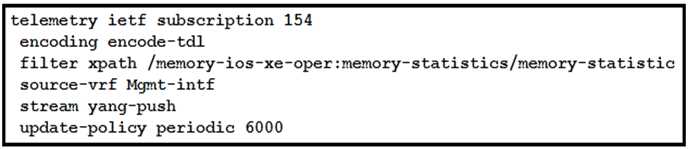
The configuration commands are entered in CLI config mode to configure a static telemetry
subscription on a Cisco IOS XE device. The commands are accepted by the device, but the consumer
receives
no telemetry dat
a. Which change must be made to ensure that the consumer receives the telemetry data?
It’s A. Without the receiver’s IP configured, the device won’t know where to send the telemetry data, so no data reaches the consumer despite other settings being correct.
Option A could also explain no data since receiver IP is crucial for delivery.
parameter value?
B. IP address works fine too since it’s a direct way to find a device on the network and typically used in many network tools. MAC addresses are unique, but sometimes IPs are more commonly used for device queries, especially if you’re looking for a device actively connected. Platform type and software version are way too generic to pinpoint a specific device in a system like this. So I’d go with B if you want a solid alternative.
It’s D because MAC address is a unique identifier that makes the most sense for device details. IP could change, and platform or software version are too broad.
request helps to determine issue details, impacted hosts, or suggested actions for the resolution?
Maybe A is the call that actually lists all current issues broadly, which could include impacted hosts and suggested fixes. B and C look more specific or detailed, but A seems like a good starting point for broad issue info.
B vs C? B seems like the main issues endpoint, but C might offer deeper detail.
Drag and drop the code from the bottom onto the box where the code is missing to construct a
Python script to automate the process of updating the site-to-site VPN settings of the network. Not
all options are used.
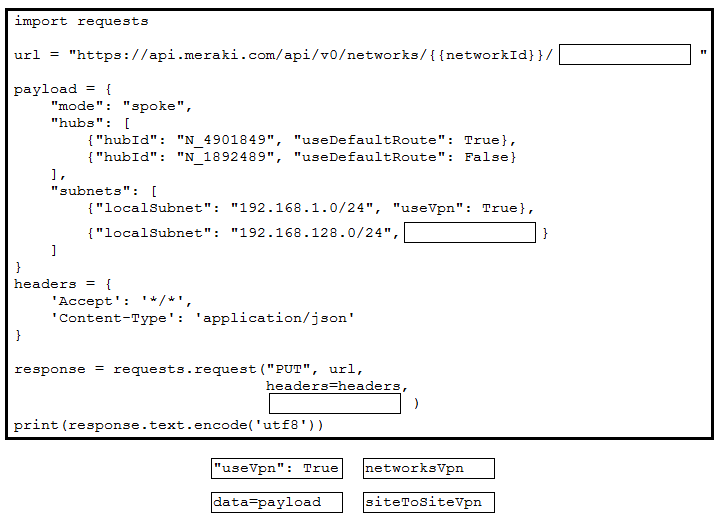
Option D seems right since it directly updates VPN settings, perfect for the blank.
I actually think option D might be the better fit here because it looks like it’s handling the VPN configuration update specifically, which is what the blank spot needs. Option C does handle authentication, but maybe that’s already done earlier in the script. The core missing piece seems to be the actual update command, so D makes more sense for that box.
Drag and drop the characteristics from the left onto the network types on the right.
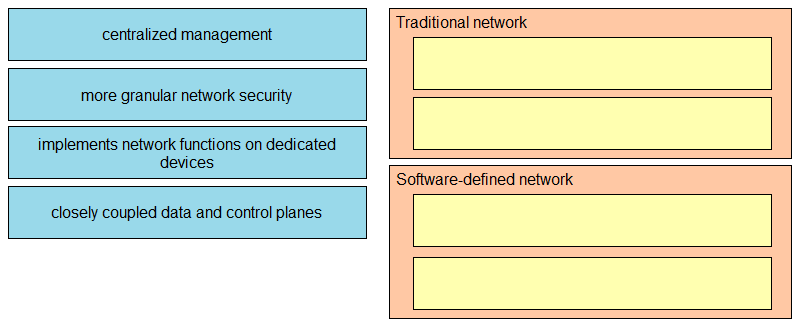
I thought about this differently: for the wireless LAN option, “limited range” fits better than just “small area” because wireless signals don’t usually cover the entire building without repeaters. Also, WANs generally have “high latency” compared to LANs, so if that’s a characteristic listed, it should go with WAN. This might help distinguish between similar options, especially when features like “uses public networks” can sometimes confuse us if we think about VPNs.
I’d put things like “covers a small area” with LAN since WAN usually spans really big distances. Also, “uses public networks” fits WAN better because local networks are private mostly. That should help clear some confusion.
Maybe D, since NETCONF uniquely validates candidate datastore contents before commit.
D imo, only NETCONF has built-in candidate datastore validation, RESTCONF lacks it.
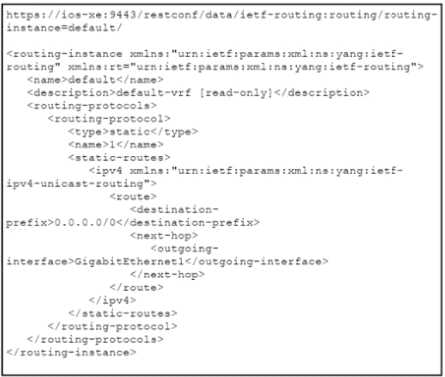
A RESTCONF GET request is sent to a Cisco IOS XE device. The base URL of the request and the
response in XML format are shows in the exhibit. what is the YANG data node that is referenced in
the response?
B vs D? The XML tags show a wrapping element called static-routes, which looks like a container grouping routes rather than just a list or leaf list. D seems broader than what’s shown.
It’s B. The response XML clearly wraps the static-route info inside a container called static-routes, which fits the YANG container type better than just a list or leaf list.