The questions for this exam were last updated on January 7, 2026
Dumps Box (DumpsBox) offers up-to-date practice exam questions for CTFL4 certification exam which are developed and validated by BCS subject domain experts certified in BCS CTFL4 . These practice questions are update regularly as we keep an eye on any recent changes in CTFL4 syllabus, and when there is update our team quickly adjusts the questions. This commitment to providing the best quality exam prep material to certification aspirants is what makes DumpsBox.com the best certification exam prep website. On top of that, our strong, yet strictly moderated, community based feedback keeps the content clean and current. Each question has helpful community discussion that provides it extra perspective and introduces helpful resources for better exam preparation. This also saves students from other outdated practice questions or illicit exam dumps that can have adverse affects on career. Browse through our BCS CTFL4 exam questions and pass your exam on first try.
Which one of the following is a typical entry criteria for testing?
Select one option, then reveal solution.
Question No. 2
Which of the following statements about checklist-based testing is TRUE?
Select one option, then reveal solution.
Question No. 3
To be able to define testable acceptance criteria, specific topics need to be addressed. In the table below are the topics matched to an incorrect description. Match the topics (the left column) with the correct description (the right column) Topic Description A: Functional behaviour A: How the system performs the specific behaviour. 8: Quality characteristics B: A sequence of actions between an external actor and the system, to accomplish a specific goal or business task. C: Scenarios C: The externally observable behaviour with user actions as input operating under certain configurations. D: Business rules D; Description of the connections between the system to be developed and the outside world. E: External interfaces E: Activities that can only be performed in the system under certain conditions defined by outside procedures and constraints.
Select one option, then reveal solution.
Question No. 4
As a tester, as part of a V-model project, you are currently executing some tests aimed at verifying if a mobile app asks the user to grant the proper access permissions during the installation process and after the installation process. The requirements specification states that in both cases the app shall ask the user to grant access permissions only to the camera and photos stored on the device. However, you observe that the app also asks the user to grant access permission to all contacts on the device. Consider the following items: [I]. Test environment [ii]. Expected result [iii]. Actual result. [IV] Test level. [V]. Root cause. Based on only the given information, which of the items listed above, are you able to CORRECTLY specify in a defect report?
Select one option, then reveal solution.
Question No. 5
A test status report SHOULD:
Select one option, then reveal solution.
Question No. 6
A typical objective of testing is to
Select one option, then reveal solution.
Question No. 7
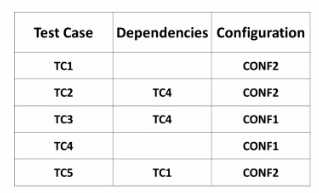
For each test case to be executed, the following table specifies its dependencies and the required configuration of the test environment for running such test case: Assume that C0NF1 is the initial configuration of the test environment Based on this assumption, which of the following is a test execution schedule that is compatible with the specified dependencies and allows minimising the number of switches between the different configurations of the test environment^
Select one option, then reveal solution.
Question No. 8
During iteration planning, a scrum team uses an estimation technique called planning poker to estimate the effort required to deliver a critical user story. In advance of the estimation session, the team agreed on some ground rules to limit the number of poker rounds and save time. The team agreed on the following: 1. They will use the following progression for estimation: Extra-small, Small, Medium, Large, Extra- large, and Extra-extra-large. 2. If estimation values differ significantly, the highest score will be used for estimation purposes. The result of the first round of planning poker: Team Member Estimation Business Large Development Extra-extra-large Testing Extra-extra-large Which of the following options best represent the team’s next actions?
Select one option, then reveal solution.
Question No. 9
Which of the following is a factor that contributes to a successful review?
Select one option, then reveal solution.
Question No. 10
Which of the following statements about retrospectives is TRUE?
Select one option, then reveal solution.
Question No. 11
Consider an estimation session in which a six-member Agile team (Memb1..... Memb6) uses the planning poker technique to estimate a user story (in story points). The team members will use a set of cards with the following values: 1,2, 3,5, 8,13,21. Below is the outcome of the first round of estimation for this session: Which of the following answers BEST describes how the estimation session should proceed?
Select one option, then reveal solution.
Question No. 12
Which of the following about typical information found within a test plan is FALSE?
Select one option, then reveal solution.
Question No. 13
Which of the following is a test task that usually occurs during test implementation?
Select one option, then reveal solution.
Question No. 14
Which two of the following statements describe the advantages provided by good traceability between the test basis and test work products? I . Analyzing the impact of changes. ii . A measure of code quality. iii . Accurate test estimation. iv . Making testing auditable. Select the
Question No. 15
During which main group of test activity are the following tasks performed? • Checking test results and logs against specified coverage criteria. • Assessing the level of component or system quality based on test results and logs. • Determining whether more tests are needed. Select the