Free Arcitura Education S90.20 Actual Exam Questions
Dumps Box (DumpsBox) offers up-to-date practice exam questions for S90.20 certification exam which are developed and validated by Arcitura Education subject domain experts certified in Arcitura Education S90.20 . These practice questions are update regularly as we keep an eye on any recent changes in S90.20 syllabus, and when there is update our team quickly adjusts the questions. This commitment to providing the best quality exam prep material to certification aspirants is what makes DumpsBox.com the best certification exam prep website. On top of that, our strong, yet strictly moderated, community based feedback keeps the content clean and current. Each question has helpful community discussion that provides it extra perspective and introduces helpful resources for better exam preparation. This also saves students from other outdated practice questions or illicit exam dumps that can have adverse affects on career. Browse through our Arcitura Education S90.20 exam questions and pass your exam on first try.
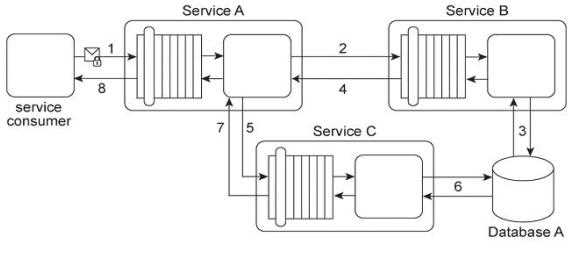
number of service consumers permitted to access Service A concurrently is strictly controlled. Service
A validates request messages based on the supplied credentials (1). If the authentication of the
request message is successful, Service A sends a message to Service B (2) to retrieve the required
data from Database A (3). Service A stores the response from Service B (4) in memory and then issues
a request message to Service C (5). Service C retrieves a different set of data from Database A (6) and
sends the result back to Service A (7). Service A consolidates the data received from Services B and C
and sends the generated report in the response message to its service consumer (8).
This service composition was recently shut down after it was discovered that Database A had been
successfully attacked twice in a row. The first type of attack consisted of a series of coordinated
request messages sent by the same malicious service consumer, with the intention of triggering a
range of exception conditions within the database in order to generate various error messages. The
second type of attack consisted of a service consumer sending request messages with malicious
input with the intention of gaining control over the database server. This attack resulted in the
deletion of database records and tables. An investigation revealed that both attacks were carried out
by malicious service consumers that were authorized. How can the service composition security
architecture be improved to prevent these types of attacks?
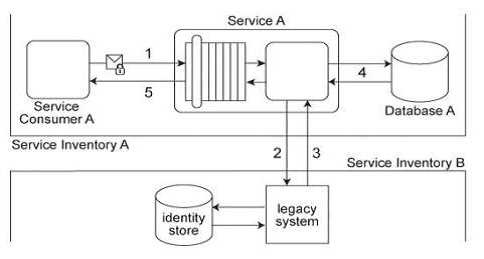
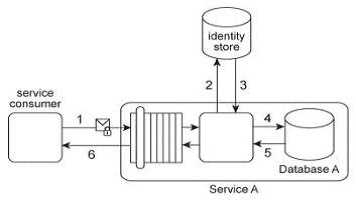
identity store that Service A needs to use in order to authenticate the security credentials can only be
accessed via a legacy system that resides in a different service inventory. Therefore, to authenticate
Service Consumer A, Service A must first forward the security credentials to the legacy system (2).
The legacy system then returns the requested identity to Service A (3). Service A authenticates
Service Consumer A against the identity received from the legacy system. If the authentication is
successful, Service A retrieves the requested data from Database A (4), and returns the data in a
response message sent back to Service Consumer A (5). Service A belongs to Service Inventory A
which further belongs to Security Domain A and the legacy system belongs to Service Inventory B
which further belongs to Security Domain B .(The legacy system is encapsulated by other services
within Service Inventory B, which are not shown in the diagram.) These two security domains trust
each other. Communication between Service A and the legacy system is kept confidential using
transport-layer security. It was recently discovered that a malicious attacker, posing as Service
Consumer A, has been accessing Service A .An investigation revealed that these attacks occurred
because security credentials supplied by Service Consumer A were transmitted in plaintext.
Furthermore, vulnerabilities to replay attacks and malicious intermediaries have been detected.
Which of the following statements describes a solution that can counter these types of attacks?
Also, list the industry standards required by the proposed solution.
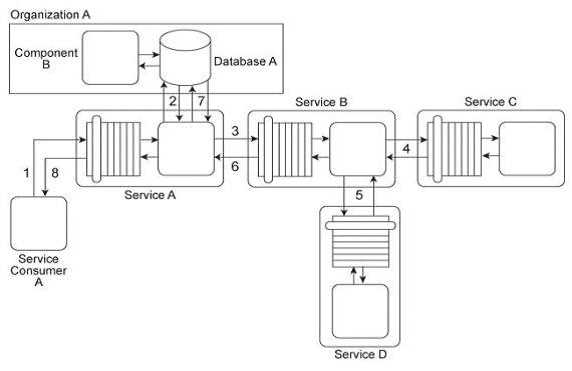
data from Database A (2). Service A then sends a request message with the retrieved data to Service
B (3). Service B exchanges messages with Service C (4) and Service D (5), which perform a series of
calculations on the data and return the results to Service A .Service A uses these results to update
Database A (7) and finally sends a response message to Service Consumer A (8). Component B has
direct, independent access to Database A and is fully trusted by Database A .Both Component B and
Database A reside within Organization A .Service Consumer A and Services A, B, C, and D are external
to the organizational boundary of Organization A .
Component B is considered a mission critical program that requires guaranteed access to and fast
response from Database A .Service A was recently the victim of a denial of service attack, which
resulted in Database A becoming unavailable for extended periods of time (which further
compromised Component B). Additionally, Services B, C, and D have repeatedly been victims of
malicious intermediary attacks, which have further destabilized the performance of Service A .How
can this architecture be improved to prevent these attacks?
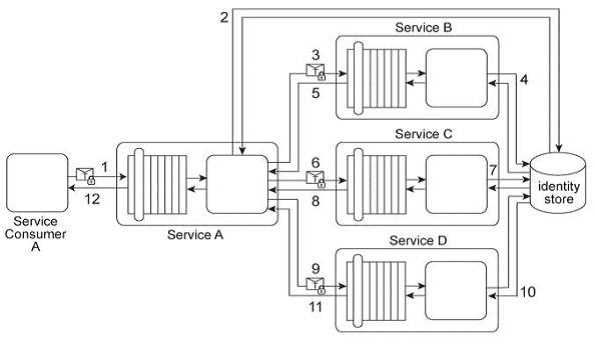
authenticates the request by verifying the security credentials from the Username token with a
shared identity store (2), To process Service Consumer A's request message. Service A must use
Services B, C, and D .Each of these three services also requires the Username token (3. 6, 9) in order
to authenticate Service Consumer A by using the same shared identity store (4, 7, 10). Upon each
successful authentication, each of the three services (B, C, and D) issues a response message back to
Service A (5, 8, 11). Upon receiving and processing the data in all three response messages, Service A
sends its own response message to Service Consumer A (12). There are plans implement a single
sign-on security mechanism in this service composition architecture. The service contracts for
Services A, C, and D can be modified with minimal impact in order to provide support for the
additional messaging requirements of the single sign-on mechanism. However, Service B's service
contract is tightly coupled to its implementation and, as a result, this type of change to its service
contract is not possible as it would require too many modifications to the underlying service
implementation. Given the fact that Service B's service contract cannot be changed to support single
sign-on, how can a single sign-on mechanism still be implemented across all services?
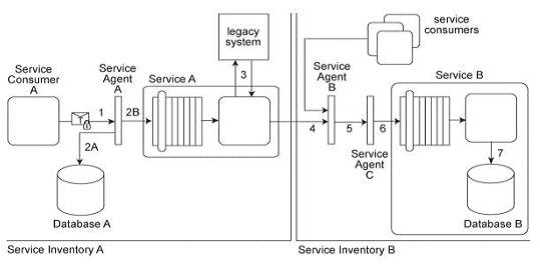
the message reaches Service A, it is intercepted by Service Agent A (1). Service Agent A validates the
security credentials and also validates whether the message is compliant with Security Policy A .If
either validation fails, Service Agent A rejects the request message and writes an error log to
Database A (2A). If both validations succeed, the request message is sent to Service A (2B). Service A
retrieves additional data from a legacy system (3) and then submits a request message to Service B
Before arriving at Service B, the request message is intercepted by Service Agent B (4) which
validates its compliance with Security Policy SIB then Service Agent C (5) which validates its
compliance with Security Policy B .If either of these validations fails, an error message is sent back to
Service A .that then forwards it to Service Agent A so that it the error can be logged in Database A
(2A). If both validations succeed, the request message is sent to Service B (6). Service B subsequently
stores the data from the message in Database B (7). Service A and Service Agent A reside in Service
Inventory A .Service B and Service Agents B and C reside in Service Inventory B .Security Policy SIB is
used by all services that reside in Service Inventory B .Service B can also be invoked by other service
consumers from Service Inventory B .Request messages sent by these service consumers must also
be compliant with Security Policies SIB and B .Access to the legacy system in Service Inventory A is
currently only possible via Service A, which means messages must be validated for compliance with
Security Policy A .A new requirement has emerged to allow services from Service Inventory B to
access the legacy system via a new perimeter service that will be dedicated to processing request
messages from services residing in Service Inventory B .Because the legacy system has no security
features, all security processing will need to be carried out by the perimeter service. However, there
are parts of Security Policy A that are specific to Service A and do not apply to the legacy system or
the perimeter service. Furthermore, response messages sent by the perimeter service to services
from Service Inventory B will still need to be validated for compliance to Security Policy B and
Security Policy SIB .How can the Policy Centralization pattern be correctly applied without
compromising the policy compliance requirements of services in both service inventories?
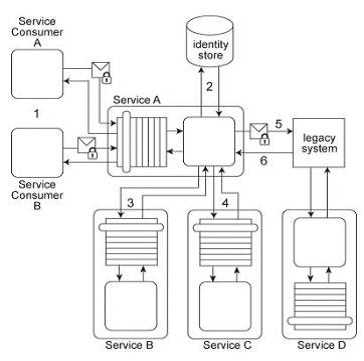
service consumers are required to provide security credentials in order for Service A to perform
authentication using an identity store (2). If a service consumer's request message is successfully
authenticated, Service A processes the request by exchanging messages with Service B (3) and then
Service C (4). With each of these message exchanges, Service A collects data necessary to perform a
query against historical data stored in a proprietary legacy system. Service A's request to the legacy
system must be authenticated (5). The legacy system only provides access control using a single
account. If the request from Service A is permitted, it will be able to access all of the data stored in
the legacy system. If the request is not permitted, none of the data stored in the legacy system can
be accessed. Upon successfully retrieving the requested data (6), Service A generates a response
message that is sent back to either Service Consumer A or B .The legacy system is also used
independently by Service D without requiring any authentication. Furthermore, the legacy system
has no auditing feature and therefore cannot record when data access from Service A or Service D
occurs. If the legacy system encounters an error when processing a request, it generates descriptive
error codes. This service composition architecture needs to be upgraded in order to fulfill the
following new security requirements:
1. Service Consumers A and B have different access permissions and therefore, data received from
the legacy system must be filtered prior to issuing a response message to one of these two service
consumers.
2. Service Consumer A's request messages must be digitally signed, whereas request messages from
Service Consumer B do not need to be digitally signed. Which of the following statements describes a
solution that fulfills these requirements?
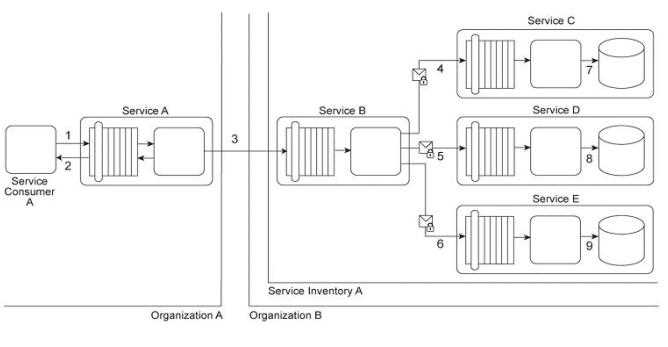
message (2) and then processes the request and sends a request message to Service B (3). This
message contains confidential financial data. Service B sends three different request messages
together with its security credentials to Services C .D .and E (4, 5, 6). Upon successful authentication,
Services C .D .and E store the data from the message in separate databases (7.8, 9). Services B .C .D,
and E belong to Service Inventory A, which further belongs to Organization B .Service Consumer A
and Service A belong to Organization A .Organization B decides to create a new service inventory
(Service Inventory B) for services that handle confidential data. Access to these services is restricted
by allocating Service Inventory B its own private network. Access to this private network is further
restricted by a dedicated firewall. Services C, D and E are moved into Service Inventory B, and as a
result. Service B can no longer directly access these services. How can this architecture be changed to
allow Service B to access Services C, D and E in a manner that does not jeopardize the security of
Service Inventory B while also having a minimal impact on the service composition's performance?
database records accessed by Service A are classified as either private or public. There are two types
of service consumers that use Service A:
Service consumers with public access permissions (allowed to access only public data records) and
service consumers with private access permissions (allowed to access all data records). For
performance reasons the Service A architecture uses a single database, named Database A .Each
record in Database A is classified as either private or public. After Service A is invoked by a service
consumer (1), it authenticates the request message using an identity store and retrieves the
corresponding authorization (2, 3). Once authorized, the service consumer's request is submitted to
Database A (4), which then returns the requested data (5) If the service consumer has private access
permissions, all of the returned data is included in Service A's response message (6). If the service
consumer has public access permissions, then Service A first filters the data in order to remove all
unauthorized private data records, before sending to the response message to the service consumer
(6). An investigation recently detected that private data has been leaked to unauthorized service
consumers. An audit of the Service A architecture revealed that Service A's filtering logic is flawed,
resulting in situations where private data was accidentally shared with service consumers that only
have public access permissions. Further, it was discovered that attackers have been monitoring
response messages sent by Service A in order to capture private data. It is subsequently decided to
split Database A into two databases:
one containing only private data (the Private Database) and the other containing only public data
(the Public Database). What additional changes are necessary to address these security problems?
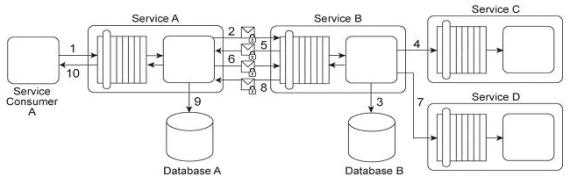
message with security credentials to Service B (2). Service B authenticates the request and, if the
authentication is successful, writes data from the request message into Database B (3). Service B
then sends a request message to Service C (4), which is not required to issue a response message.
Service B then sends a response message back to Service A (5). After processing Service B's response,
Service A sends another request message with security credentials to Service B (6). After successfully
authenticating this second request message from Service A, Service B sends a request message to
Service D (7). Service D is also not required to issue a response message. Finally, Service B sends a
response message to Service A (8), after which Service A records the response message contents in
Database A (9) before sending its own response message to Service Consumer A (10). To use Service
A, Service Consumer A is charged a per usage fee. The owner of Service Consumer A has filed a
complaint with the owner of Service A, stating that the bills that have been issued are for more usage
of Service A than Service Consumer A actually used. Additionally, it has been discovered that
malicious intermediaries are intercepting and modifying messages being sent from Service B to
Services C and D .Because Services C and D do not issue response messages, the resulting errors and
problems were not reported back to Service B .Which of the following statements describes a
solution that correctly addresses these problems?
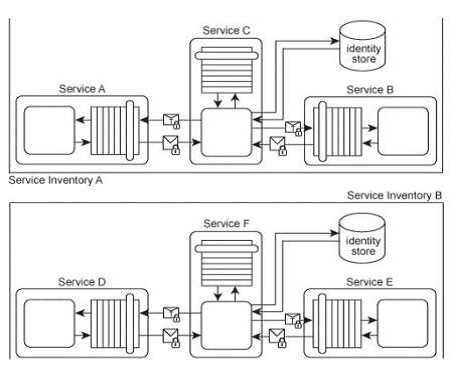
.Service C acts as an authentication broker for Service Inventory A .Service F acts as an authentication
broker for Service Inventory B .Both of the authentication brokers use Kerberos-based authentication
technologies. Upon receiving a request message from a service consumer, Services C and F
authenticate the request using a local identity store and then use a separate Ticket Granting Service
(not shown) to issue the Kerberos ticket to the service consumer. Currently, tickets issued in one
service inventory are not valid in the other. For example, if Service A wants to communicate with
Services D or E, it must request a ticket from the Service Inventory B authentication broker (Service
F). Because Service Inventory A and B trust each other, the current cross-inventory authentication is
considered unnecessarily redundant. How can these service inventory architectures be improved to
avoid redundant authentication?