Free Arcitura Education S90.08B Actual Exam Questions
Dumps Box (DumpsBox) offers up-to-date practice exam questions for S90.08B certification exam which are developed and validated by Arcitura Education subject domain experts certified in Arcitura Education S90.08B . These practice questions are update regularly as we keep an eye on any recent changes in S90.08B syllabus, and when there is update our team quickly adjusts the questions. This commitment to providing the best quality exam prep material to certification aspirants is what makes DumpsBox.com the best certification exam prep website. On top of that, our strong, yet strictly moderated, community based feedback keeps the content clean and current. Each question has helpful community discussion that provides it extra perspective and introduces helpful resources for better exam preparation. This also saves students from other outdated practice questions or illicit exam dumps that can have adverse affects on career. Browse through our Arcitura Education S90.08B exam questions and pass your exam on first try.
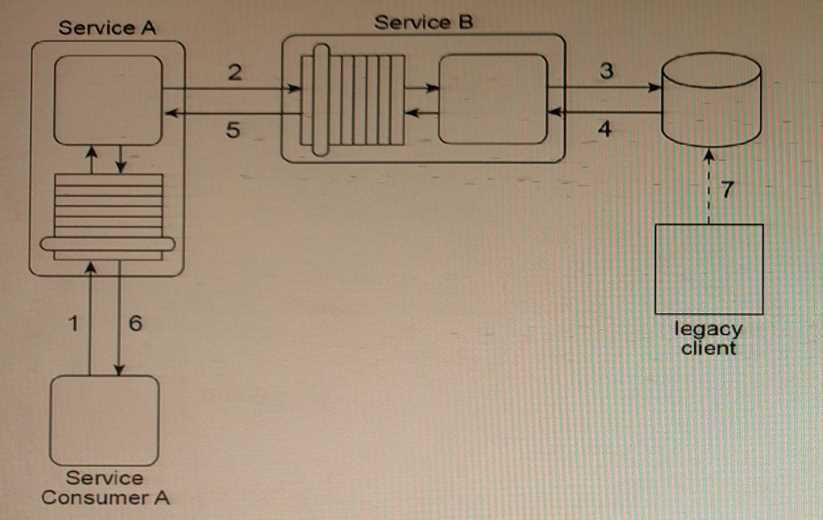
Service A is an entity service that provides a Get capability which returns a data value that is
frequently changed.
Service Consumer A invokes Service A in order to request this data value (1). For Service A to carry
out this request, it must invoke Service B (2), a utility service that interacts (3, 4) with the database in
which the data value is stored. Regardless of whether the data value changed, Service B returns the
latest value to Service A (5), and Service A returns the latest value to Service Consumer A (6).
The data value is changed when the legacy client program updates the database (7). When this
change will occur is not predictable. Note also that Service A and Service B are not always available at
the same time.
Any time the data value changes, Service Consumer A needs to receive It as soon as possible.
Therefore, Service Consumer A initiates the message exchange shown In the figure several times a
day. When it receives the same data value as before, the response from Service A Is ignored. When
Service A provides an updated data value, Service Consumer A can process it to carry out its task.
The current service composition architecture is using up too many resources due to the repeated
invocation of Service A by Service Consumer A and the resulting message exchanges that occur with
each invocation.
What steps can be taken to solve this problem?
Refer to Exhibit. 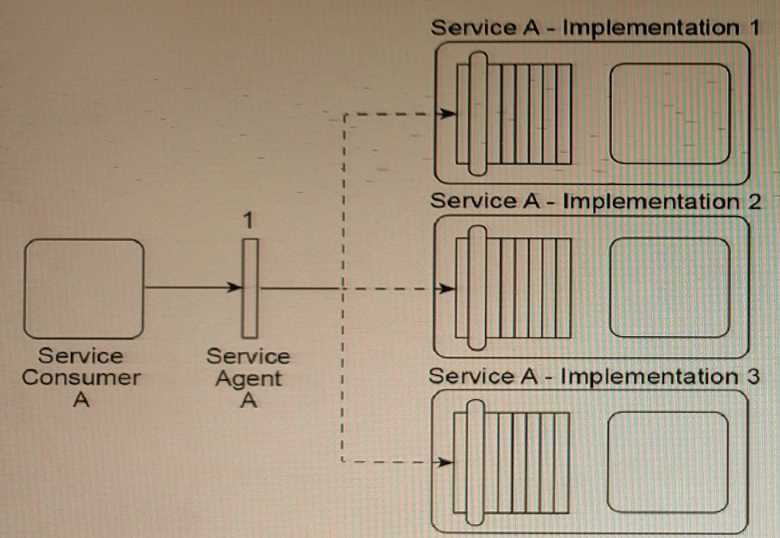 Service Consumer A sends a message to Service A. There are currently three duplicate implementations of Service A (Implementation 1, Implementation 2 and Implementation 3). The message sent by Service Consumer A is intercepted by Service Agent A (1), which determines at runtime which implementation of Service A to forward the message to. All three implementations of Service A reside on the same physical server. You are told that despite the fact that duplicate implementations of Service A exist, performance is still poor at times. You are also informed that a new service capability will soon need to be added to Service A to introduce functionality that will require access to a shared database being used by many other clients and applications in the IT enterprise. This is expected to add further performance demands on Service A. How can this service architecture be changed to improve performance in preparation for the addition of the new service capability?
Refer to Exhibit. 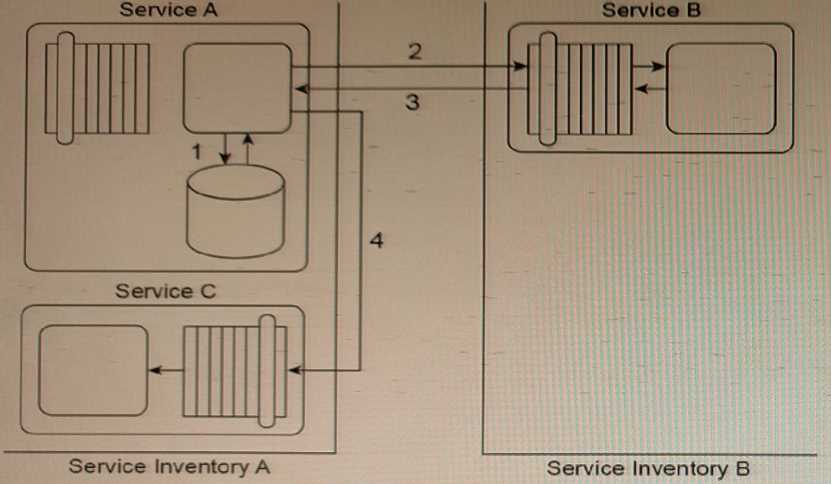 Service A is a task service that sends Service B a message (2) requesting that Service B return data back to Service A in a response message (3). Depending on the response received, Service A may be required to send a message to Service C (4) for which it requires no response. Before it contacts Service B, Service A must first retrieve a list of code values from its own database (1) and then place this data into its own memory. If it turns out that it must send a message to Service C, then Service A must combine the data it receives from Service B with the data from the code value list in order to create the message it sends to Service C. If Service A is not required to invoke Service C, it can complete its task by discarding the code values. Service A and Service C reside in Service Inventory A. Service B resides in Service Inventory B. You are told that the services in Service Inventory A were designed with service contracts that are based on different design standards and technologies than the services In Service Inventory B. As a result, Service A is a SOAP-based Web service and Service B Is a REST service that exchanges JSON- formatted messages. Therefore, Service A and Service B cannot currently communicate. Furthermore, Service C is an agnostic service that is heavily accessed by many concurrent service consumers. Service C frequently reaches its usage thresholds, during which it is not available and messages sent to it are not received. What steps can be taken to solve these problems?
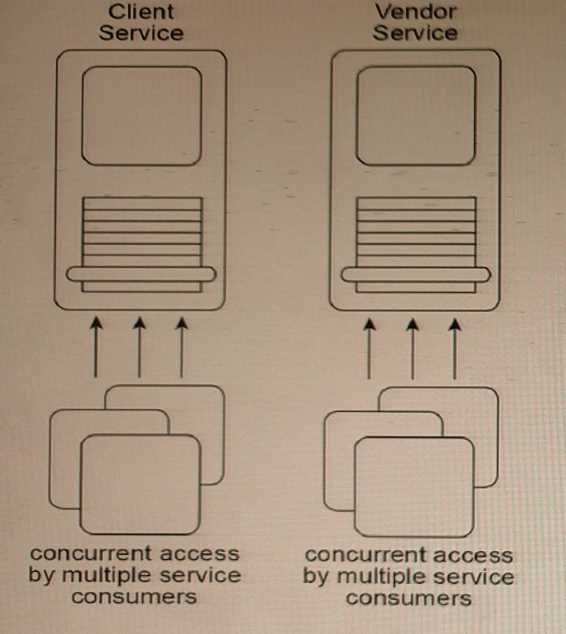
The Client and Vendor services are agnostic services that are both currently part of multiple service
compositions. As a result, these services are sometimes subjected to concurrent access by multiple
service consumers.
The Client service primarily provides data access logic to a client database but also coordinates with
other services to determine a clients credit rating. The Vendor service provides some data access
logic but can also generate various dynamic reports based on specialized business requirements.
After reviewing historical statistics about the runtime activity of the two services, it is discovered that
the Client service is serving an ever-increasing number of service consumers. It is regularly timing
out, which in turn increases its call rate as service consumers retry their requests. The Vendor service
occasionally has difficulty meeting its service-level agreement (SLA) and when this occurs, penalties
are assessed.
Recently, the custodian of the Client service was notified that the Client service will be made
available to new service consumers external to its service inventory. The Client service will be
providing free credit rating scores to any service consumer that connects to the service via the
Internet. The Vendor service will remain internal to the service inventory and will not be exposed to
external access.
Which of the following statements describes a solution that addresses these issues and
requirements?
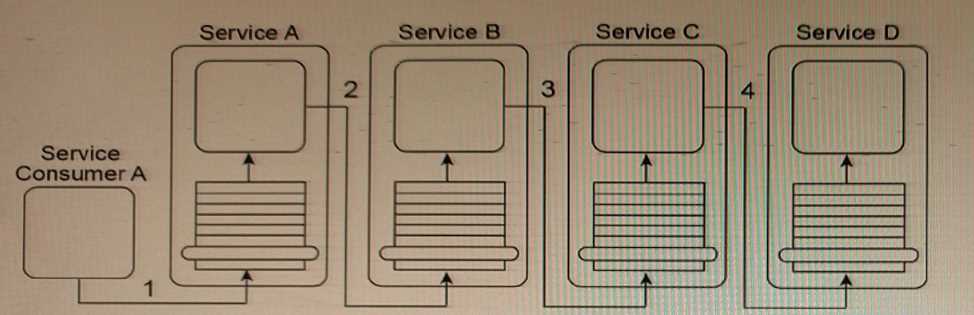
Service Consumer A sends a message to Service A (1), which then forwards the message to Service B
(2). Service B forwards the message to Service C (3), which finally forwards the message to Service D
(4). However, Services A, B and C each contain logic that reads the contents of the message to
determine what intermediate processing to perform and which service to forward the message to.
As a result, what is shown in the diagram is only one of several possible runtime scenarios.
Currently, this service composition architecture is performing adequately, despite the number of
services that can be involved in the transmission of one message. However, you are told that new
logic is being added to Service A that will require it to compose one other service to retrieve new
data at runtime that Service A will need access to in order to determine where to forward the
message to. The involvement of the additional service will make the service composition too large
and slow.
What steps can be taken to improve the service composition architecture while still accommodating
the new requirements and avoiding an increase in the amount of service composition members?
Refer to Exhibit. 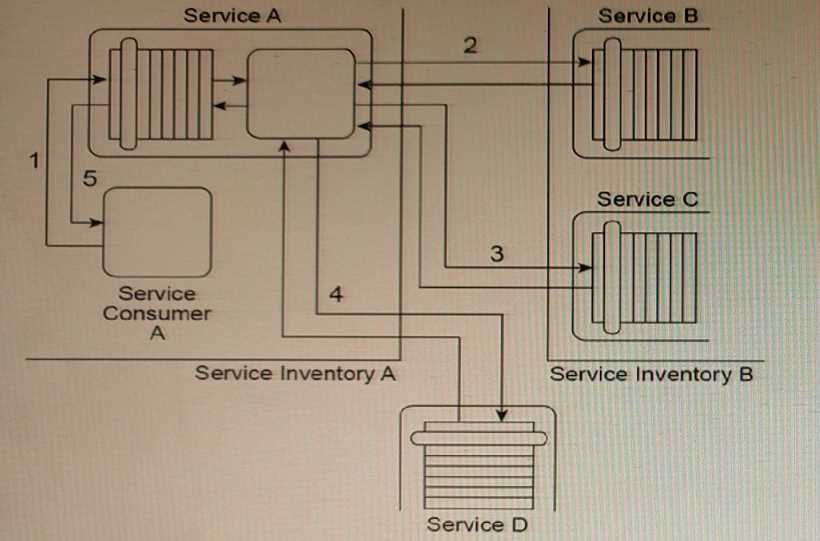 Service Consumer A and Service A reside in Service Inventory A. Service B and Service C reside in Service Inventory B. Service D is a public service that can be openly accessed via the World Wide Web. The service is also available for purchase so that it can be deployed independently within IT enterprises. Due to the rigorous application of the Service Abstraction principle within Service Inventory B, the only information that is made available about Service B and Service C are the published service contracts. For Service D, the service contract plus a service level agreement (SLA) are made available. The SLA indicates that Service D has a planned outage every night from 11:00pm to midnight. You are an architect with a project team that is building services for Service Inventory A. You are told that the owners of Service Inventory A and Service Inventory B are not generally cooperative or communicative. Cross-inventory service composition is tolerated, but not directly supported. As a result, no SLAs for Service B and Service C are available and you have no knowledge about how available these services are. Based on the service contracts you can determine that the services in Service Inventory B use different data models and a different transport protocol than the services in Service Inventory A. Furthermore, recent testing results have shown that the performance of Service D is highly unpredictable due to the heavy amount of concurrent access it receives from service consumers from other organizations. You are also told that there is a concern over how long Service Consumer A will need to remain stateful while waiting for a response from Service A. What steps can be taken to solve these problems?
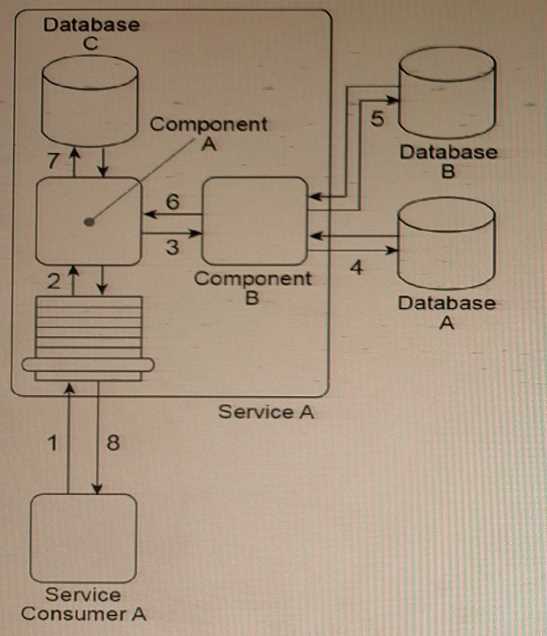
Service Consumer A sends Service A a message containing a business document (1). The business
document is received by Component A, which keeps the business document in memory and forwards
a copy to Component B (3). Component B first writes portions of the business document to Database
A (4). Component B then writes the entire business document to Database B and uses some of the
data values from the business document as query parameters to retrieve new data from Database B
(5).
Next, Component B returns the new date* back to Component A (6), which merges it together with
the original business document it has been keeping in memory and then writes the combined data to
Database C (7). The Service A service capability invoked by Service Consumer A requires a
synchronous request-response data exchange. Therefore, based on the outcome of the last database
update, Service A returns a message with a success or failure code back to Service Consumer A (8).
Databases A and B are shared, and Database C is dedicated to the Service A service architecture.
There are several problems with this architecture. The business document that Component A is
required to keep in memory (while it waits for Component B to complete its processing) can be very
large. The amount of runtime resources Service A uses to keep this data in memory can decrease the
overall performance of all service instances, especially when it is concurrently invoked by multiple
service consumers. Additionally, Service A can take a long time to respond back to Service Consumer
A because Database A is a shared database that sometimes takes a long time to respond to
Component B. Currently, Service Consumer A will wait for up to 30 seconds for a response, after
which it will assume the request to Service A has failed and any subsequent response messages from
Service A will be rejected.
What steps can be taken to solve these problems?
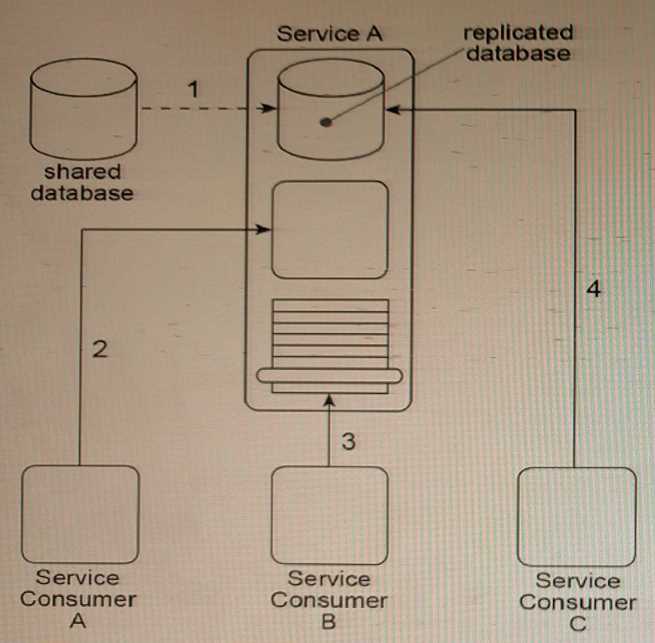
Service A is a utility service that provides generic data access logic to a database containing data that
is periodically replicated from a shared database (1). Because the Standardized Service Contract
principle was applied to the design of Service A, its service contract has been fully standardized.
The service architecture of Service A Is being accessed by three service consumers. Service Consumer
A accesses a component that is part of the Service A Implementation by Invoking it directly (2).
Service Consumer B invokes Service A by accessing Its service contract (3). Service Consumer C
directly accesses the replicated database that Is part of the Service A Implementation (4).
You've been told that the reason Service Consumers A and C bypass the published Service A service
contract is because, for security reasons, they are not allowed to access a subset of the capabilities in
the API that comprises the Service A service contract. How can the Service A architecture be changed
to enforce these security restrictions while avoiding negative forms of coupling?
Refer to Exhibit. 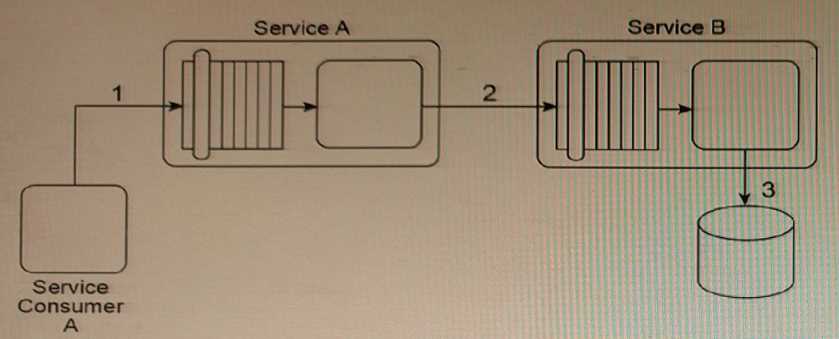 Service A is a SOAP-based Web service with a functional context dedicated to invoice-related processing. Service B is a REST-based utility service that provides generic data access to a database. In this service composition architecture, Service Consumer A sends a SOAP message containing an invoice XML document to Service A (1). Service A then sends the invoice XML document to Service B (2), which then writes the invoice document to a database (3). The data model used by Service Consumer A to represent the invoice document is based on XML Schema A. The service contract of Service A is designed to accept invoice documents based on XML Schema B. The service contract for Service B is designed to accept invoice documents based on XML Schema A. The database to which Service B needs to write the invoice record only accepts entire business documents in a proprietary Comma Separated Value (CSV) format. Due to the incompatibility of the XML schemas used by the services, the sending of the invoice document from Service Consumer A through to Service B cannot be accomplished using the services as they currently exist. Assuming that the Contract Centralization pattern is being applied and that the Logic Centralization pattern is not being applied, what steps can be taken to enable the sending of the invoice document from Service Consumer A to the database without adding logic that will increase the runtime performance requirements?
Refer to Exhibit. 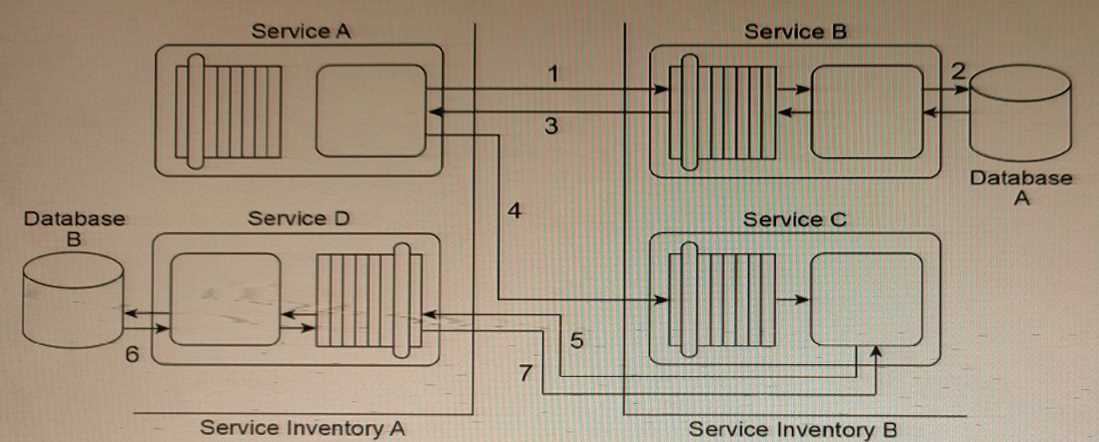 Service A sends a message to Service B (1). After Service B writes the message contents to Database A (2), it issues a response message back to Service A (3). Service A then sends a message to Service C (4). Upon receiving this message, Service C sends a message to Service D (5), which then writes the message contents to Database B (6) and issues a response message back to Service C (7). Service A and Service D are located in Service Inventory A. Service B and Service C are located in Service Inventory B. You are told that In this service composition architecture, all four services are exchanging invoice- related data in an XML format. However, the services in Service Inventory A are standardized to use a different XML schema for invoice data than the services in Service Inventory B. Also, Database A can only accept data in the Comma Separated Value (CSV) format and therefore cannot accept XML- formatted data. Database B only accepts XML-formatted data. However, it is a legacy database that uses a proprietary XML schema to represent invoice data that is different from the XML schema used by services in Service Inventory A or Service Inventory B. What steps can be taken to enable the planned data exchange between these four services?