Free Arcitura Education C90.06 Actual Exam Questions
Dumps Box (DumpsBox) offers up-to-date practice exam questions for C90.06 certification exam which are developed and validated by Arcitura Education subject domain experts certified in Arcitura Education C90.06 . These practice questions are update regularly as we keep an eye on any recent changes in C90.06 syllabus, and when there is update our team quickly adjusts the questions. This commitment to providing the best quality exam prep material to certification aspirants is what makes DumpsBox.com the best certification exam prep website. On top of that, our strong, yet strictly moderated, community based feedback keeps the content clean and current. Each question has helpful community discussion that provides it extra perspective and introduces helpful resources for better exam preparation. This also saves students from other outdated practice questions or illicit exam dumps that can have adverse affects on career. Browse through our Arcitura Education C90.06 exam questions and pass your exam on first try.
Cloud Service A requires access to Cloud Storage Device A, which contains LUNs A and B. Cloud Service A is hosted by Virtual Server A, which resides on Hypervisor A on Physical Server A. Virtual Server B hosts Cloud Service B and Cloud Service C. Cloud Service Consumer A accesses Cloud Service A (1), which then accesses LUN A or B on Cloud Storage Device A (2). After receiving the requested data from Cloud Service A, Cloud Service Consumer A forwards the data to Cloud Service B (3), which then writes it to Cloud Storage Device B (4). 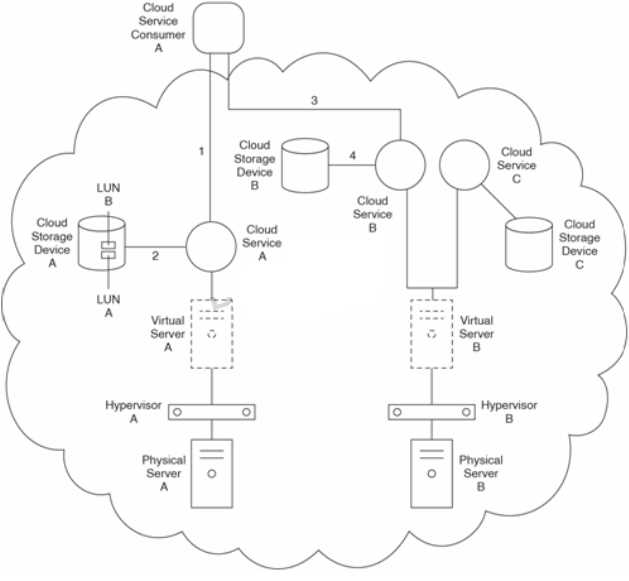
 Cloud Service Consumer A belongs to Organization A, Organization A uses LUN A and LUN B on Cloud Storage Device A to store their important client account data. Cloud Storage Device A is a low-performance cloud storage device, which begins to cause performance issues as more data is added to LUNs A and B and as Cloud Service Consumer A performs data access requests more frequently. Organization A asks that its cloud architecture be upgraded to process increased quantities of data and higher volumes of data requests. Organization A has been leasing a PaaS environment that it used to build Cloud Service A, which it would like to make available to the general public. Organization A needs to establish a system capable of monitoring usage of Cloud Service A for billing purposes. The cloud provider is using a usage data collection and reporting system that gathers information on Organization A's hosted IT resources approximately ten hours after the time of usage. One day, Organization A attempts to retrieve information on whether Virtual Server B has available Cloud Service C instances. They discover that they are unable to obtain the current status of Virtual Server B. Organization A demands a system that provides instant availability reporting. Which of the following statements lists the patterns that can be applied to solve these three requirements and problems?
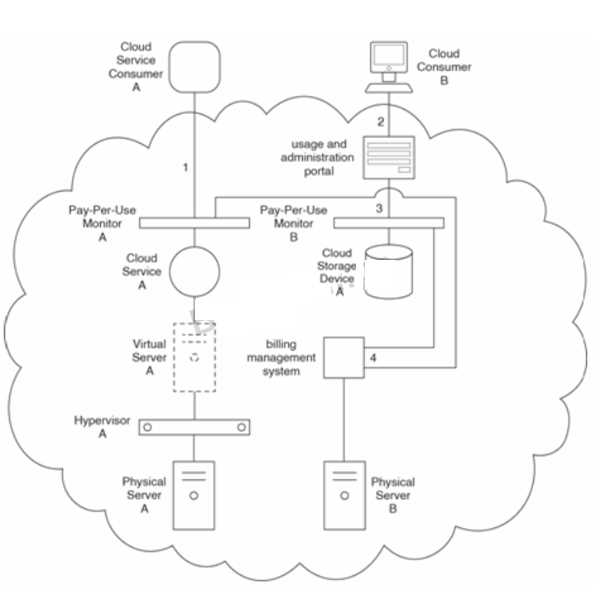
Physical Server A. Cloud Storage Device A is used to store media library data that is continuously
replicated with a redundant, secondary implementation of Cloud Storage A (not shown). Access to
Cloud Service A is monitored by Pay-Per-Use Monitor A. Access to Cloud Storage Device A is
monitored by Pay-Per-Use Monitor B. Pay-Per-Use Monitors A and B capture billing-related usage
data that is forwarded to a billing management system that is hosted by Physical Server B.
Cloud Service Consumer A accesses Cloud Service A and the usage data is captured by Pay-Per-Use
Monitor A (1). Cloud Consumer B accesses Cloud Storage Device A via a usage and administration
portal that it uses to upload media data (2). This usage is captured by Pay-Per-Use Monitor B (3). Pay-
Per-Use Monitors A and B store collected usage data in the billing management system (4), which is
later used by the cloud provider to bill for the usage of Cloud Service A and Cloud Storage Device A.
Each service instance of Cloud Service A requires a virtual server with 2 virtual CPUs and 4 GBs of
RAM at a package price of $2.00 for each initial invocation and an additional $0.50 for each
consecutive 60 seconds of usage. Cloud Service Consumer A accesses Cloud Service A twice in one
day. The two exchanges with Cloud Service A last 60 seconds and 120 seconds. For that one day, the
organization that owns Cloud Service Consumer A is billed $6.50, which it determines is incorrect.
After complaining to the cloud provider, it is discovered that the rapid provisioning system
responsible for provisioning instances of Cloud Service A is not de-provisioning Cloud Service A when
Cloud Service Consumer A indicates it has completed an exchange. Instead, Cloud Service A is de-
provisioned after a 60 second timeout that occurs after Cloud Service Consumer A is completed with
an exchange.
Storage space on Cloud Storage Device A can only be purchased in units of terabytes (TBs), with each
TB costing $1 per day. Cloud Consumer B purchases 5 TBs of storage space on day 1 and stores 5 TBs
of data on days 6 and 7. Cloud Consumer B was expecting to be billed $10.00, but is billed $35. After
raising a complaint, Cloud Consumer B is informed by the cloud provider that cloud consumers are
billed based on the allocation of storage space, regardless of how much storage space they actually
use.
Which of the following statements describes a solution that can update the cloud architecture to
avoid these billing-related problems and discrepancies?
cluster comprised of three virtual servers. Virtual Server A hosts Ready-Made Environment A. Ready-
Made Environment A uses Cloud Storage Device A to store data related to the ready-made
environment and its users. Cloud Service A is hosted by a high-availability (HA) virtual server cluster.
Hypervisor A is a cluster-enabled hypervisor.
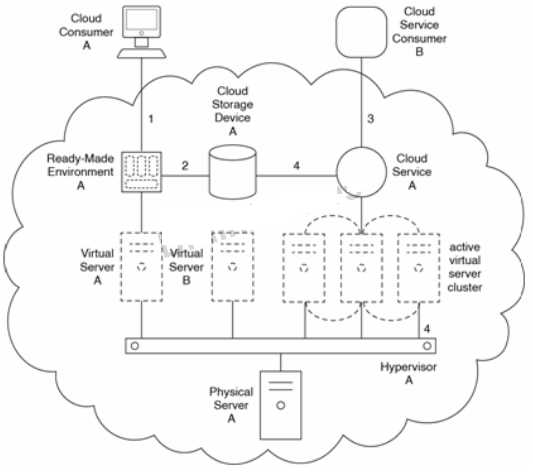
Developers access Ready-Made Environment A to work on the development of a new solution (1).
During this usage. Ready-Made Environment A regularly reads and writes data to Cloud Storage
Device A (2). Cloud Service Consumer B accesses Cloud Service A (3). Cloud Service A queries data
residing in Cloud Storage Device A in response to processing requests from Cloud Service Consumer
B (4).
Hypervisor A is made part of a cluster of hypetvisors. Ready-Made Environment A, which is still
hosted by Virtual Server Aon Hypervisor A, subsequently becomes unexpectedly unavailable. It then
takes twenty minutes to pass before Virtual Server A and Ready-Made Environment A become
available again on Hypervisor B (a hypervisor that is also part of the hypervisor cluster). This delay is
considered unacceptable by Cloud Consumer A. Furthermore, after being relocated
to Hypervisor B, Virtual Server A is unable to connect to the network. By the time the cloud provider
rectifies this second problem, Cloud Consumer A experiences a total of two hours of downtime.
Which of the following statements describes a solution that can minimize or entirely avoid a delay for
the runtime relocation of Ready-Made Environment A?
Cloud Service A accesses LUN Aon Cloud Storage Device A when it receives requests to process data from cloud consumers. Cloud Service A is hosted by Virtual Server A. The usage and administration portal can be used to access and manage the data in Cloud Storage Device B, which is also hosted by Virtual Server A. Virtual Server A is further hosted by Hypervisor A, which resides on Physical Server A. Virtual Server B is part of a virtual server cluster hosted by Hypervisor B. which resides on Physical Server B. Physical Server C is not in use and does not yet have an operating system installed. Cloud Service Consumer A sends a request to Cloud Service A (1), which accesses data in LUN Aon Cloud Storage Device A (2). Cloud Consumer B uses the usage and administration portal to upload new data (3). The data is placed in LUN B on Cloud Storage Device B (4). Cloud Service Consumer A and Cloud Consumer B belong to Organization A, which is leasing Virtual Server A and Virtual Server B from the cloud provider. Organization A also proceeds to lease Physical Server C as part of a new laaS agreement it signs with the cloud provider. Organization A wants to provision Physical Server C with a number of legacy systems that cannot be deployed on virtual servers. However, when it attempts to do so, it realizes that its laaS package only provides Physical Server C as an out-of-the-box hardware server without anything installed on it. In order to deploy its legacy systems Organization A requires that Physical Server C first has an operating system installed, but it has no means of remotely provisioning Physical Server C with an operating system. 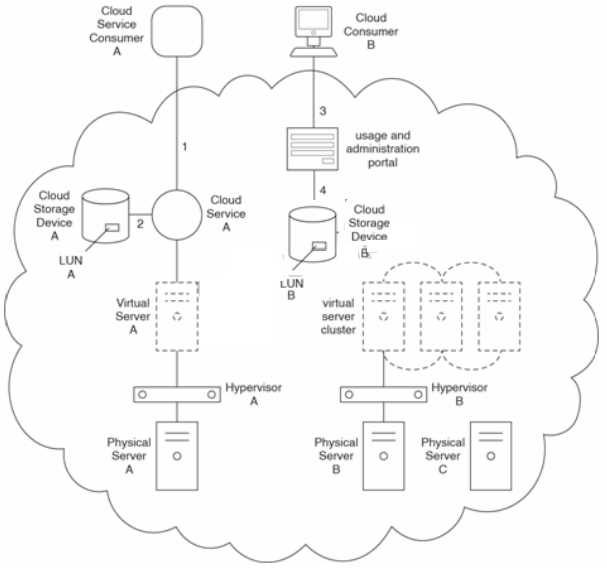 Organization A would like to deploy two of its legacy systems on Virtual Server A and to further extend Cloud Service A's functions so that it can be used as an external interface for cloud service consumers to access legacy system features. Additionally, Organization A would like to deploy three of its mission-critical legacy systems on Virtual Server B in order to take advantage of the additional performance and failover benefits provided by the virtual server cluster that Virtual Server B is part of. Each of the five legacy systems is comprised of dozens of components that need to be installed individually. Instead of manually installing each component of each legacy system, Organization A would like to customize workflows that can automate these deployment tasks. During the first few months of working with its cloud-based legacy systems. Organization A receives a number of complaints from users that the cloud-based legacy systems are at times behaving erratically. However, when cloud resource administrators with Organization A review the cloud provider's reports that log usage, downtime and other runtime characteristics, they do not find any indication of erratic behavior or any other comparable problems. After some further investigation, the cloud resource administrators determine that the nature of the erratic behavior is specific to proprietary features of the legacy systems and is therefore not monitored or logged by the cloud provider's standard audit monitor, pay-per-use monitor or automated scaling listener. The cloud resource administrators recommend that a new service agent be developed with features customized to monitor the legacy systems. Which of the following statements provides a solution that can address Organization A's requirements?
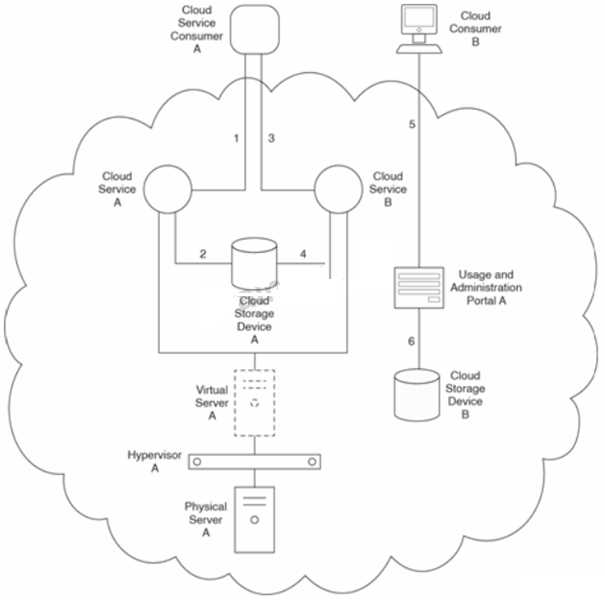
Storage Device A when fulfilling requests from cloud service consumers that require data access.
Cloud Services A and B are hosted by Virtual Server A, which is hosted by Hypervisor A on Physical
Server A.
Cloud Service Consumer A accesses Cloud Service A to issue a request for data (1). Cloud Service A
queries a database in Cloud Storage Device A to retrieve the data (2). Upon receiving the requested
data, Cloud Service Consumer A combines it with additional data to form a new collection of data.
Cloud Service Consumer A then accesses Cloud Service B and provides it with the new data (3). Cloud
Service B accesses a different database in Cloud Storage Device A to store the new data (4). Cloud
Consumer B accesses the usage and administration portal to upload new data (5). The data is
uploaded to Cloud Storage Device B (6).
Cloud Service Consumer A belongs to Organization A. Cloud Consumer B belongs to Organization B.
Cloud Service A is a SaaS product offered by the cloud provider to the general public, and is therefore
used by numerous cloud consumers from different organizations at different times. Cloud Service B is
also a SaaS product as part of the same overall solution as Cloud Service A.
However, because a given cloud service consumer only needs to access Cloud Service B when the
data it receives from Cloud Service A meets certain criteria, it is not used nearly as much as Cloud
Service A. Cloud Service A currently has a hard threshold allowing no more than 10 concurrent
instances of it to exist at once. One day, Cloud Service Consumer A attempts to access Cloud Service
A as the eleventh cloud service consumer, and is predictably rejected.
Cloud Service Consumer A belongs to Organization A, one of the cloud provider's most important
customers. Therefore, when Organization A complains about not being able to access Cloud Service A
during peak usage times, the cloud provider agrees to provide a solution.
As a result of a natural disaster, the cloud provider's data center that houses Physical Server A
becomes unexpectedly unavailable. Physical Server A subsequently becomes unavailable for nearly
two days. This outage exceeds what the cloud provider guaranteed in its original SLA and the cloud
provider agrees to not charge Organization for usage fees for an entire month as compensation.
However, the unavailability of Physical Server A had a significant impact on Organization As business,
resulting in financial loss and loss of confidence of its clients.
Organization A informs the cloud provider that it cannot continue working with this cloud unless the
cloud provider can guarantee that the availability of Physical Server A will no longer be dependent on
a single data center or a single geographic region.
Organization B receives its latest monthly invoice from the cloud provider and discovers that the
charges are identical to the invoice it received last month, even though the usage and administration
portal shows that its data usage is a third less. They bring this issue to the attention of the cloud
provider and are informed that they are currently subscribed to a fixed-allocation plan.
The cloud provider explains that in order to get them on a plan whereby they are charged only for
actual data usage, Cloud Storage Device B would need to be upgraded and a system capable of
tracking runtime usage would need to be established. Organization B asks the cloud provider to make
these changes.
Which of the following statements provides a solution that can address Organization A's and
Organization B's issues?
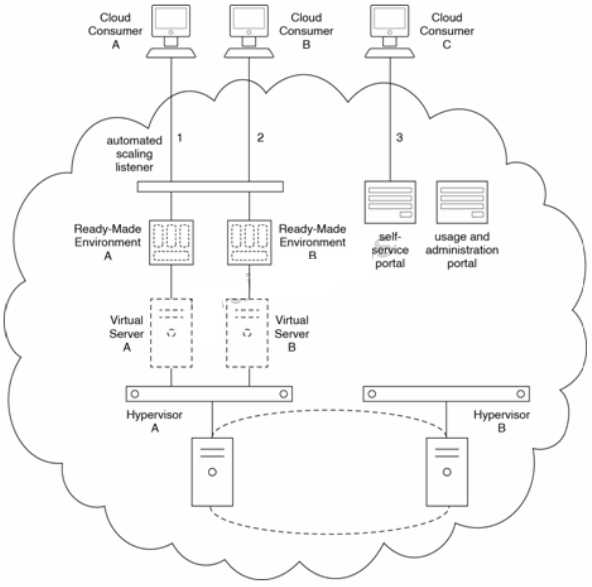
by Virtual Server B. Virtual Servers A and B are hosted by Hypervisor A, which is part of a hypervisor
cluster. An automated scaling listener intercepts cloud consumer requests and automatically invokes
the on-demand generation of additional instances of ready-made environments, as required.
A self-service portal and a usage and administration portal are also available to cloud consumers.
The self-service portal can be used to request the provisioning of a new ready-made environment.
Any cloud consumer that has already had a ready-made environment provisioned can configure and
view information about that ready-made environment via the usage and administration portal.
Cloud Consumer A accesses Ready-Made Environment A to work on the development of a new cloud
service (1). Cloud Consumer B accesses Ready-Made Environment B to test a recently completed
application comprised of three cloud services (2). Cloud Consumer C accesses the self-service portal
to request the creation of a new ready-made environment (3).
The cloud provider is required to perform an emergency maintenance outage on a cloud storage
device used by all ready-made environments. The unplanned outage takes two hours. During this
period, Cloud Consumers A and B are unable to access Ready-Made Environments A and B and Cloud
Consumer C receives an error when submitting a request to create a new ready-made environment.
After the maintenance outage is over, Cloud Consumers A and B encounter the following problems:
Cloud Consumer A is unable to recover session data that was kept in memory for an extended
period, prior to the time of the outage.
Cloud Consumer B has no access to Virtual Server B, which was moved to Hypervisor B during the
maintenance outage. When Cloud Consumer B attempts to ping Virtual Server B, the request times
out.
Even though Cloud Consumer C is able to log into the usage and administration portal to confirm that
its ready-made environment was successfully provisioned, the unexpected outage has raised
concerns about the stability of the ready-made environment's underlying infrastructure. Cloud
Consumer C informs the cloud provider that it cannot proceed with its lease of the ready-made
environment if there are future occurrences of this type of maintenance outage.
Which of the following statements can help address the problems and concerns of the three cloud
consumers?
Virtual Server A and Virtual Server B are hosted by Hypervisor A, which resides on Physical Server A. Virtual Server A hosts Cloud Service A. Virtual Server C. Virtual Server D, Virtual Server E and Virtual Server F are hosted by Hypervisor B on Physical Server B. Physical Server C, which hosts Hypervisor C, is currently not being used. Cloud Service Consumer A accesses Cloud Service A (1), which accesses files stored in a folder on Virtual Server A (2). Cloud Consumer B uses Proprietary User Portal A to administer legacy software (not shown) installed on Virtual Server D (3). Proprietary User Portal B and Proprietary User Portal C are also available for accessing additional legacy systems located on Virtual Server F; however, they are not often used. 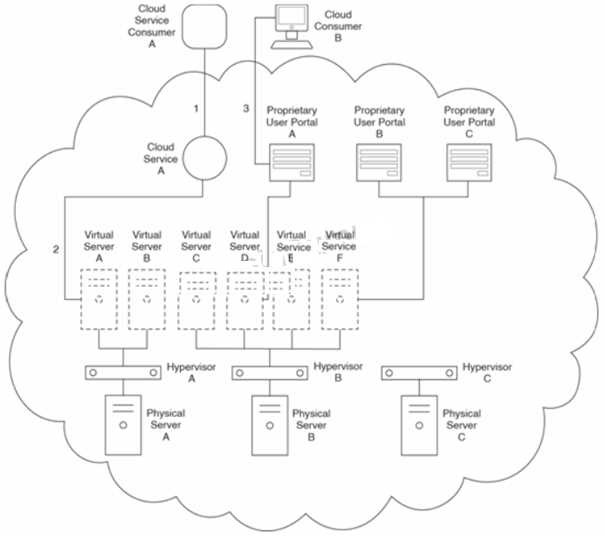 The cloud shown in the figure is a private cloud. Department A and Department B share IT resources within the private cloud and are part of the same organization. Cloud Service Consumer A belongs to Department A and Cloud Consumer B belongs to Department B. During routine access of Cloud Service A by Cloud Service Consumer A, the Department A cloud resource administrator is notified that a hardware fault is occurring within Physical Server A that will soon cause it to fail. The cloud resource administrator scrambles to arrange for Cloud Service A to be relocated but is unable to do so before Physical Server A does fail. It takes several more hours of downtime until, with the cooperation of the cloud provider, the Cloud Service A implementation is successfully moved to Physical Server C and made live again. Managers at Department A demand that a system be put in place to avoid this scenario in the future. Cloud Service A was initially developed specifically for Department A's Cloud Service Consumer A. However, recently Department B has indicated that it will be developing its own cloud service consumer that will also need to regularly access Cloud Service A. After this new cloud service consumer is deployed, both Department A and Department B experience occasional runtime errors when their cloud service consumers attempt to access Cloud Service A at the same time. Cloud Service A accesses a legacy system on Virtual Server A that requires regular updates and patches to stay current. Each time the legacy system is updated, Cloud Service A needs to undergo an update as well, during which it needs to be temporarily unavailable. Department A managers ask the cloud provider to extend the cloud architecture so that a duplicate, secondary implementation of Cloud Service A can be made available while the primary implementation undergoes a maintenance update. Which of the following statements provide a solution that can adequately resolve all of Departments A and B's issues?
Virtual Server B is hosted by Hypervisor B on Physical Server B.
Cloud Service Consumer A accesses Cloud Service A and the request is intercepted by an SLA monitor
(1). Cloud Service A receives the request (2) and accesses Cloud Storage Device A and Cloud Storage
Device B (3).
Cloud Service Consumer A belongs to Organization A, which is leasing all of the IT resources shown in
the figure as part of an laaS environment.
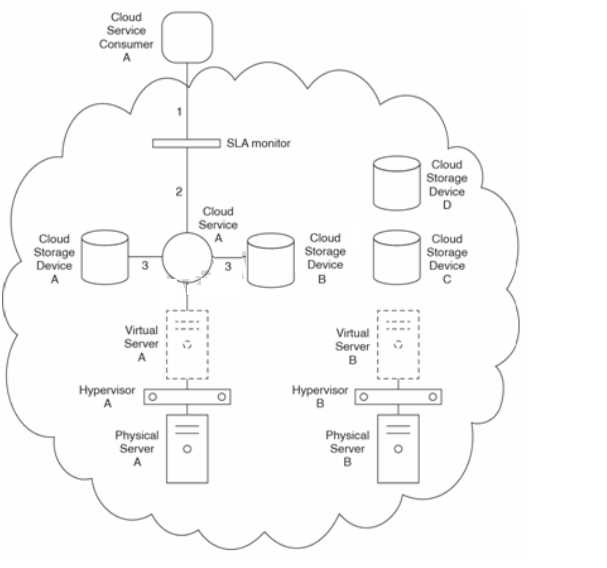
Cloud Storage Device B has a higher performance capacity than Cloud Storage Device A. Cloud
Storage Device C has a higher performance capacity than Cloud Storage Device B. The requests being
received by Cloud Service A from Cloud Service Consumer A have recently increased in both quantity
and in the amount of data being queried, written and read from Cloud Storage Device A. As a result,
Cloud Storage Device A's capacity is frequently reached and it has become unstable at times, timing
out with some requests and rejecting other requests.
Cloud Storage Device C is used by Organization A to store backup data on a daily basis. One day, a
hardware failure within Cloud Storage Device C results in the permanent loss of data.
Organization A requires a system that will prevent this type of failure from resulting in data loss.
The cloud provider is planning to implement a routine maintenance schedule for Cloud Storage
Devices A, B, and C and issues a notice stating that the new schedule will start next week. An outage
of 30 minutes every Thursday and Sunday at 8:00 PM is needed for the maintenance tasks. Upon
hearing this, Organization A complains that they cannot afford to have Cloud Storage Devices A and B
become inoperable, especially not during the weekdays.
Which of the following statements describes a solution that can address Organization A's issues?
Cloud Service A is hosted by Virtual Server A. Cloud Storage Device A contains LUN A. Cloud Storage Device A is a multi-tiered cloud storage device with different types of disk groups that perform at different levels. LUN A is located in the disk group with the highest performance level. Cloud Service B is hosted by Virtual Server B. Virtual Servers A and B are hosted by HypervisorA, which is installed on a physical server (not shown) that resides in Cloud A. A redundant implementation of LUN A is replicated synchronously to Cloud Storage Device C. Cloud Storage Device C does not support multiple types of disk groups and resides in Cloud B, which is located in a different geographic region than Cloud A. Requests that cloud service consumers send to Cloud Services A and B are intercepted by an automated scaling listener responsible for initiating scaling activities. 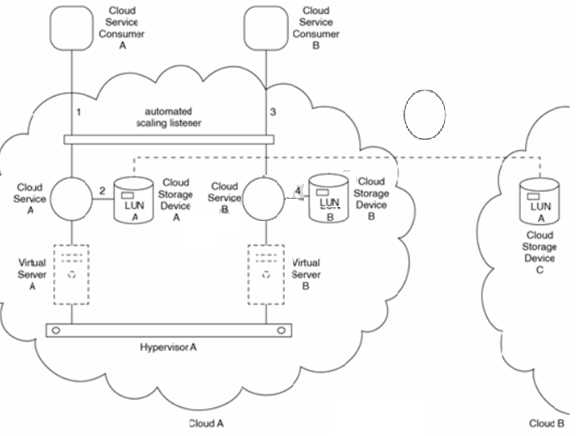 Cloud Service Consumer A issues a request to Cloud Service A (1). To process the request, Cloud Service A accesses LUN Aon Cloud Storage Device A (2). Cloud Service Consumer B issues a request to Cloud Service B (3). To process the request, Cloud Service B accesses LUN B on Cloud Storage Device B (4). When Cloud Service Consumer A accesses Cloud Service A, there is usually no noticeable performance fluctuation, even during peak usage periods. However, recently, Cloud Storage Device A became unexpectedly unavailable, requiring that Cloud Service A access LUN A on Cloud Storage Device C instead. During the following outage period for Cloud Storage Device A, Cloud Service Consumer A encounters inconsistent performance from Cloud Service A, including unusual delays that occur whenever the data requested by Cloud Consumer A isn't cached and Cloud Service A is required to retrieve the data from LUN A. Which of the following statements describes a solution that can address this problem?
Virtual Server A is hosted by Hypervisor A, which resides on Physical Server A. Virtual Server A hosts Cloud Services A and B. Virtual Server B is hosted by Hypervisor B on Physical Server B. Physical Server C is currently not being used. Cloud Service Consumer A sends a request to Cloud Service A that is intercepted by Pay-Per-Use Monitor A (1), which collects billing-related usage data that is later forwarded to the billing management system (2). Cloud Service A receives and processes the request (3). Cloud Consumer B accesses the usage and administration portal (4) to access data on Cloud Storage Device B. Pay-Per-Use Monitor B intercepts the data access to collect and forward billing-related usage data to the billing management system (5). Cloud Storage Device B processes the data access request from Cloud Consumer B (6). 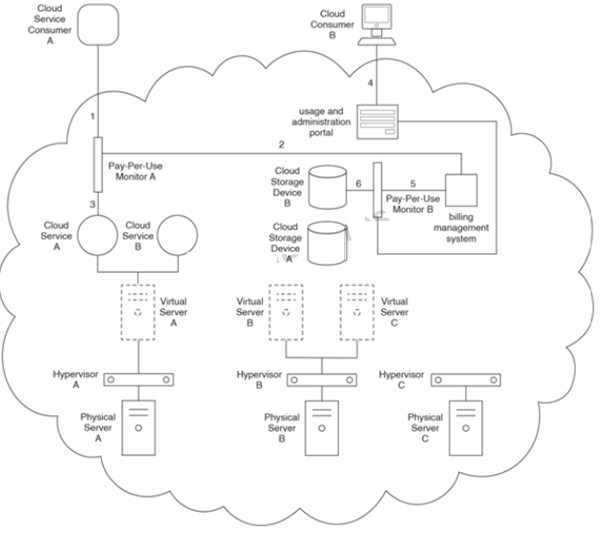 Cloud Service Consumer A and Cloud Consumer B belong to Organization A Cloud Storage Device B is accessed on a regular basis by Cloud Consumer B. However, managers at Organization A receive reports from their cloud resource administrator that Cloud Storage Device B is unavailable for longer periods and more frequently than what they expected, based on the SLA availability guarantee they were provided by the cloud provider. This results in wasted time when the cloud resource administrator attempts to upload or access data and then discovers that Cloud Storage Device B is unavailable. The cloud resource administrator requires a means of checking for the availability of Cloud Storage Device B prior to attempting access. As the workload increases on Physical Server B, Cloud Consumer B begins to receive runtime exceptions and degraded data access performance from Cloud Storage Device B. It is determined that the cause of the deteriorating performance is a network bottleneck that has formed on Physical Server B due to its bandwidth capacity being reached, primarily because of other cloud consumer organizations also sharing its hosted IT resources. Organization A receives a monthly billing statement that shows the charges for the total usage of Cloud Service A during that period. However, Organization A requires a more detailed breakdown of the types of usage and their associated costs. For example, Cloud Service Consumer A can issue requests for information by employees within Organization A and on behalf of clients of Organization A. Organization A requires a breakdown of the usage costs incurred on behalf of clients so that it can bill the clients for this usage accordingly. The cloud provider informs Organization A that it has no existing monitor that can collect and log this detailed usage information and suggests that Organization A customize its own monitor. Which of the following statements lists the patterns that can be applied to solve these three problems?