Free Arcitura Education C90.03 Actual Exam Questions
Dumps Box (DumpsBox) offers up-to-date practice exam questions for C90.03 certification exam which are developed and validated by Arcitura Education subject domain experts certified in Arcitura Education C90.03 . These practice questions are update regularly as we keep an eye on any recent changes in C90.03 syllabus, and when there is update our team quickly adjusts the questions. This commitment to providing the best quality exam prep material to certification aspirants is what makes DumpsBox.com the best certification exam prep website. On top of that, our strong, yet strictly moderated, community based feedback keeps the content clean and current. Each question has helpful community discussion that provides it extra perspective and introduces helpful resources for better exam preparation. This also saves students from other outdated practice questions or illicit exam dumps that can have adverse affects on career. Browse through our Arcitura Education C90.03 exam questions and pass your exam on first try.
The cloud service owner of Cloud Service A is evaluating Clouds X, Y and Z to determine which cloud environment can offer the greatest level of reliability. All three clouds are geographically dispersed across three separate time zones. As a result, each cloud experiences usage peaks at different times. Based on the metrics provided, the greater the usage of a cloud, the lower its reliability. When the cloud service owner complains to Cloud Provider A (the owner of all three clouds) that none of the clouds provide an adequate level of reliability, Cloud Provider A suggests a solution that increases resiliency. 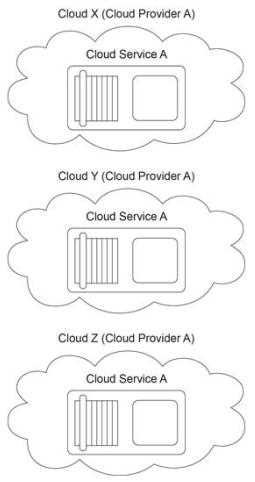 Which of the following statements accurately describes a solution that can be used to fulfill the resiliency requirements of Cloud Service A?
hosting Virtual Servers A and B. Cloud Provider X implements Cloud Service A on Virtual Server A and
makes it available to Cloud Service Consumer A, which interacts with Cloud Service A by sending and
receiving messages (1, 2). Cloud Provider Y has deployed a virtualization environment comprised of
Physical Server B hosting Virtual Servers C and D. Virtual Server C is made available to Cloud Service
Consumer B, which interacts with Virtual Server C (3,4) in order to prepare for the deployment of a
new cloud service that will be used internally by Cloud Provider Y to process data obtained from
Cloud Service A .
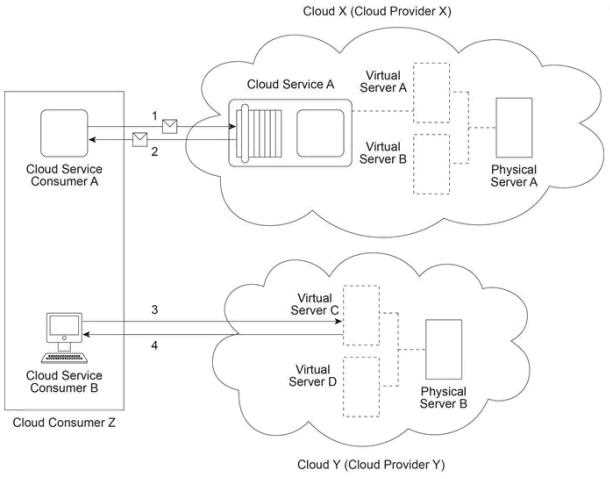
Cloud X is administered by a group of organizations and makes Cloud Service A available only to
cloud service consumers from that group. Cloud Consumer Z belongs to one of the organizations
within this group. Cloud Y and Cloud Consumer Z are owned by the same organization. Which of the
following statements provides a valid scenario that accurately describes the involvement of cloud
deployment models, cloud delivery models, roles and/or boundaries? (Note that the correct answer
represents one of multiple valid scenarios that can exist.)
model. Cloud Service A is hosted by Physical Server A that also hosts cloud services being used by
different cloud service consumers (and owned by different cloud service owners). Cloud Provider X
needs to make Cloud Service A available to a new group of cloud service consumers, but must do so
without the increase in usage volume affecting Cloud Service Consumers A and B .
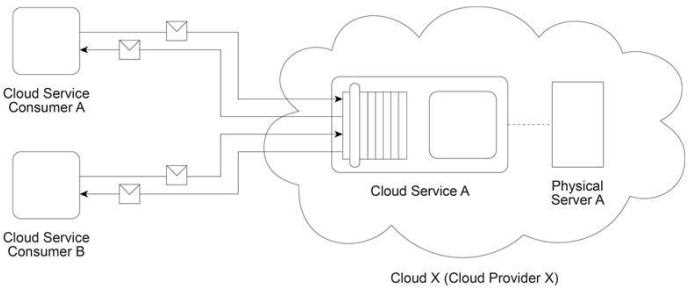
Which of the following statements does not accurately describe a solution (or a set of solutions) that
addresses this requirement?
external, cloud-based Weather Service that provides up-to-date weather forecast information. Cloud
Providers X, Y and Z are competing public cloud providers, each offering a Weather Service with the
features required by Cloud Consumer A .
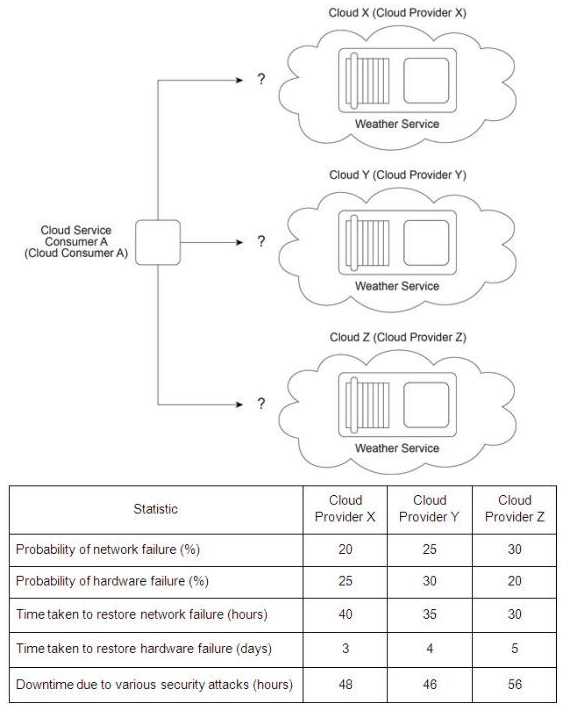
Based on the provided statistics, which cloud provider can offer a Weather Service with the least
amount of projected downtime?
physical server. Cloud Services A and B are hosted on Virtual Server A, which is hosted by Physical
Server A . Physical Server A also hosts Virtual Server B, which hosts redundant implementations of
Cloud Services A and B for load balancing purposes. Cloud Service Consumer A is accessing Cloud
Service A located on Virtual Server A . Cloud Service Consumer B is accessing Cloud Service B located
on Virtual Server B . Cloud Service Consumers A and B are both owned by Cloud Consumer X. Cloud
Consumer X has recently complained that Cloud Service A is becoming increasingly unreliable. Cloud
Provider Y launches an investigation that reveals that Virtual Server A has been crashing sporadically
due to successful malicious intermediary attacks where malicious service agents have been inserting
harmful data into messages sent by Cloud Service Consumer A to Cloud Service A
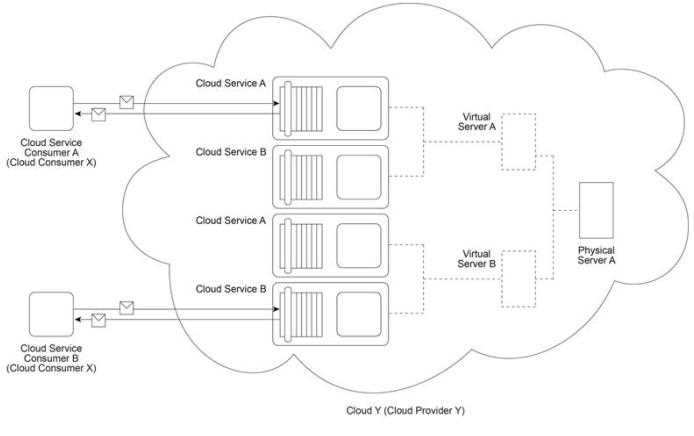
Which of the following statements describes a solution that can mitigate the malicious intermediary
attacks that have been occurring on Virtual Server A - and - can further help prevent the same types
of attacks from occurring on Virtual Server B?
Cloud X (owned by Cloud Provider X) provides Physical Server A which hosts Virtual Servers A and B. Virtual Server B hosts Ready-Made Environments A and B . Cloud Service Consumer A uses Virtual Server A as part of an IaaS leasing agreement in which Cloud Consumer A is charged a fixed monthly fee for unlimited access. Cloud Service Consumers B and C use Ready-Made Environments A and B respectively as part of a PaaS leasing agreement based on per-minute usage fees. In both cases, access is monitored via Pay-For-Use Monitor A, which keeps track of log-in and log-out times in order to calculate the usage charges that are billed to Cloud Consumers B and C . 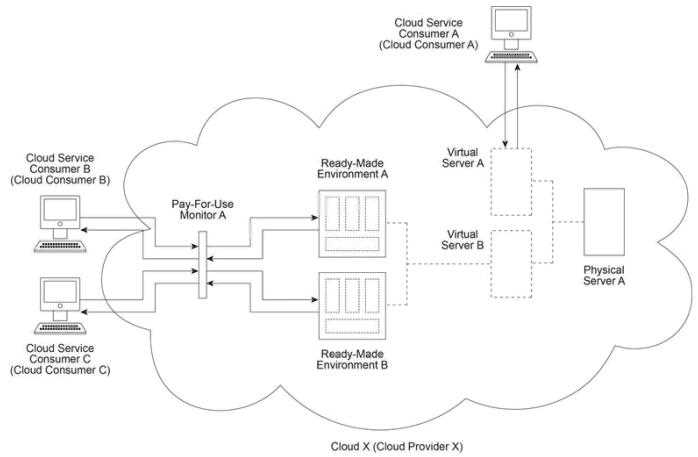 Physical Server A begins to become unstable. Over the course of a 24 hour period, the server shuts down three times, taking down Virtual Servers A and B with it. This causes numerous problems for Cloud Service Consumers A, B and C, which lose connections and encounter a variety of exceptions. A subsequent investigation of the log files generated by Pay-For-Use Monitor A reveals that the three server crashes coincided with the usage periods of Ready-Made Er n'ronment B b> Cloud Service Consumer B. De 'elopers at the Cloud Consumer 3 organization confirm they did not actually log in during those periods, which leads Cloud Provider X to discover that another cloud service consumer has been posing as Cloud Service Consumer B in order to maliciously access Ready-Made Environment B, Virtual Server B, and Physical Server B on Cloud X. The investigation concludes that the malicious cloud service consumer was able to carry out the attack successfully by obtaining a weak password being used by developers from Cloud Consumer B . Which of the following statements accurately identifies the type of security threat that corresponds to the described attack - and -provides a solution that can directly mitigate this type of security threat within Cloud X?
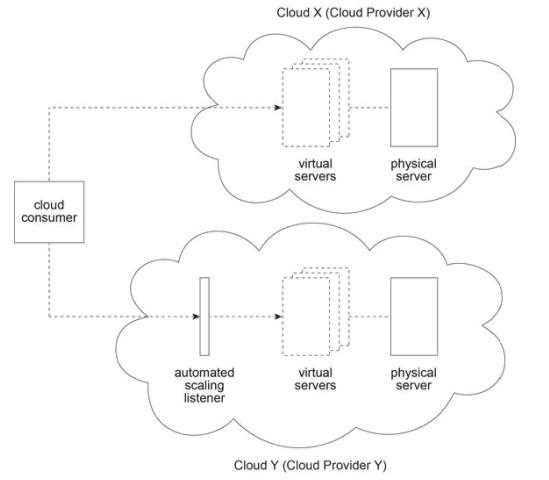
offered by Cloud Provider X and Cloud Provider Y. Cloud X (owned by Cloud Provider X) and Cloud Y
(owned by Cloud Provider Y) both provide shared physical servers that host multiple virtual servers
for other cloud consumers. The virtual servers on Cloud X are accessed directly, whereas the virtual
servers on Cloud Y are accessed via an automated scaling listener. On Cloud X, virtual servers are pre-
configured to support a specific amount of concurrent cloud service consumers. When this threshold
is exceeded, cloud service consumer requests are rejected. Due to the use of the automated scaling
listener, virtual servers on Cloud Y can provide a greater level of elasticity.
The hourly cost to the cloud consumer to use a virtual server on Cloud X is half that of the cost to use
a virtual server on Cloud Y. Within a one month period, Cloud Provider X bases its hourly charge on
the maximum number of virtual servers used. Within a one month period, Cloud Provider Y bases its
hourly charges on actual virtual server usage. Cloud Provider Y charges $20 for each hour that a
cloud consumer uses a virtual server. The cloud consumer predicts its monthly usage requirements
to be as follows:
Number Of Virtual Servers
Usage
3
20 Hours
4
30 Hours
5
50 Hours
The cloud consumer is required to choose the cloud provider with the lowest on-going cost, based on
its predicted usage. Which of the following statements accurately calculates the on-going usage costs
of Cloud Providers X and Y and correctly states the cloud provider that the cloud consumer must
choose?
The cloud service owner of Cloud Service A is evaluating Clouds X, Y and Z to determine which cloud environment can offer the greatest level of reliability. All three clouds are geographically dispersed across three separate time zones. As a result, each cloud experiences usage peaks at different times. Based on the metrics provided, the greater the usage of a cloud, the lower its reliability. When the cloud service owner complains to Cloud Provider A (the owner of all three clouds) that none of the clouds provide an adequate level of reliability, Cloud Provider A suggests a solution that increases resiliency. 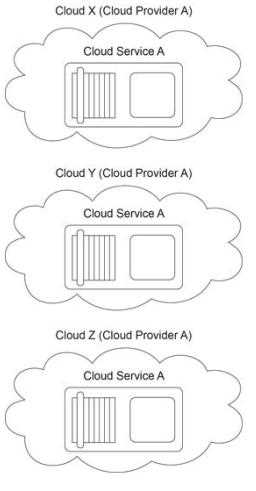 Which of the following statements accurately describe how a cloud balancing solution can be implemented to fulfill the resiliency requirements of Cloud Service A?
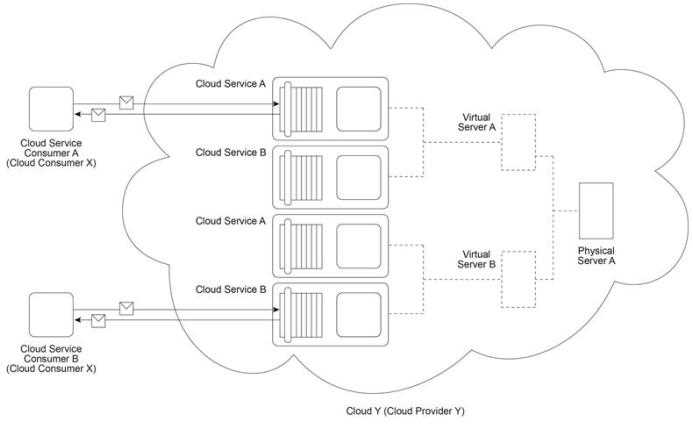
physical server. Cloud Services A and B are hosted on Virtual Server A, which is hosted by Physical
Server A . Physical Server A also hosts Virtual Server B, which hosts redundant implementations of
Cloud Services A and B for load balancing purposes. Cloud Service Consumer A is accessing Cloud
Service A located on Virtual Server A . Cloud Service Consumer B is accessing Cloud Service B located
on Virtual Server B . Cloud Service Consumers A and B are both owned by Cloud Consumer X. Cloud
Consumer X has recently complained that Cloud Services A and B have become less available than
what is guaranteed in their service level agreements (SLAs). Cloud Provider Y launches an
investigation that reveals that Virtual Servers A and B have been subjected to denial of service
attacks. This is confirmed as the cause of the decline in the availability of Cloud Services A and B.
Which of the following statements describes a solution that can increase the availability of Cloud
Services A and B?
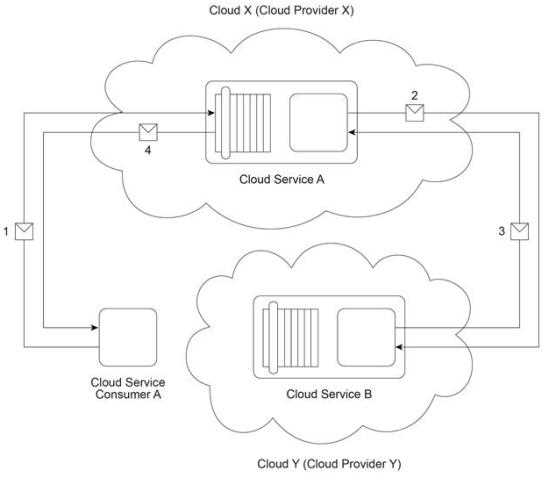
fulfill the request from Cloud Service Consumer A, Cloud Service A needs to invoke Cloud Service B
that resides on Cloud Y (owned by Cloud Provider Y) (2). After completing its processing, Cloud
Service B sends a response to Cloud Service A (3). Cloud Service A verifies the response and then
finally sends its response to Cloud Service Consumer A (4).
The guaranteed availability of the Cloud Service A implementation is 95% and the guaranteed
availability of the Cloud Service B implementation is 95%. Which of the following statements
accurately describes the actual availability that Cloud Service Consumer A can receive based on the
described scenario?