Free AIWMI CCRA-L2 Actual Exam Questions
Dumps Box (DumpsBox) offers up-to-date practice exam questions for CCRA-L2 certification exam which are developed and validated by AIWMI subject domain experts certified in AIWMI CCRA-L2 . These practice questions are update regularly as we keep an eye on any recent changes in CCRA-L2 syllabus, and when there is update our team quickly adjusts the questions. This commitment to providing the best quality exam prep material to certification aspirants is what makes DumpsBox.com the best certification exam prep website. On top of that, our strong, yet strictly moderated, community based feedback keeps the content clean and current. Each question has helpful community discussion that provides it extra perspective and introduces helpful resources for better exam preparation. This also saves students from other outdated practice questions or illicit exam dumps that can have adverse affects on career. Browse through our AIWMI CCRA-L2 exam questions and pass your exam on first try.
income trader. He interviewed four candidates Adam, Balkrishnan, Catherine and Deepak and
following are the answers to his questions.
Question 1: Tell something about Option Adjusted Spread
Adam: OAS is applicable only to bond which do not have any options attached to it. It is for the plain
bonds.
Balkishna: In bonds with embedded options, AS reflects not only the credit risk but also reflects
prepayment risk over and above the benchmark.
Catherine: Sincespreads are calculated to know the level of credit risk in the bound, OAS is difference
between in the Z spread and price of a call option for a callable bond.
Deepark: For callable bond OAS will be lower than Z Spread.
Question 2: This is a spread that must be added to the benchmark zero rate curve in a parallel shift so
that the sum of the risky bond’s discounted cash flows equals its current market price. Which Spread
I am talking about?
Adam: Z Spread
Balkrishna: Nominal Spread
Catherine: Option Adjusted Spread
Deepark: Asset Swap Spread
Question 3: What do you know about Interpolated spread and yield spread?
Adam: Yield spread is the difference between the YTM of a risky bond and the YTM of an on-the-run
treasury benchmark bond whose maturity is closest, but not identical to that of risky bond.
Interpolated spread is the spread between the YTM of risky bond and the YTM of same maturity
treasury benchmark, which is interpolated from the two nearest on-the-run treasury securities.
Balkrishna: Interpolated spread is preferred to yield spread because the latter has the maturity
mismatch, which leads to error if the yield curve is not flat and the benchmark security changes over
time, leading to inconsistency.
Catherine: Interpolated spread takes account the shape of the benchmark yield curve and therefore
better than yield spread.
Deepak: Both Interpolated Spread and Yield Spread rely on YTM which suffers from drawbacks and
inconsistencies such as the assumption of flat yield curve and reinvestment at YTM itself.
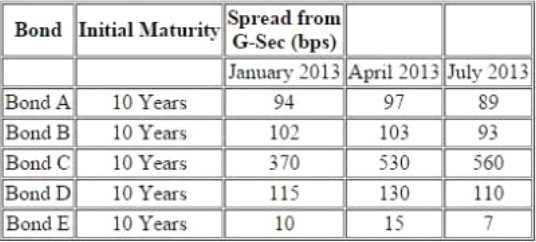
Then Satish gave following information related to the benchmark YTMs:
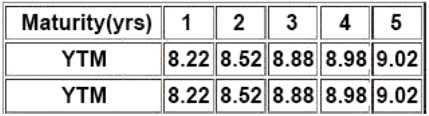
Who amongst the four candidates is correct regarding OAS?
Auckland Ltd is a public sector bank operating with about 120 branches across Indi
a. The bank has been in business since 1971 and has about 40% branches in rural areas and about
75% of all branches are in
Western India. On the basis of the size, Auckland Ltd will be ranked at number 31 amongst 40 banks
in India.
Although top management has appointment period of 5 years, generally they retire on ach sieving
age of 60 years with an average tenure of only 2 years at the top job.
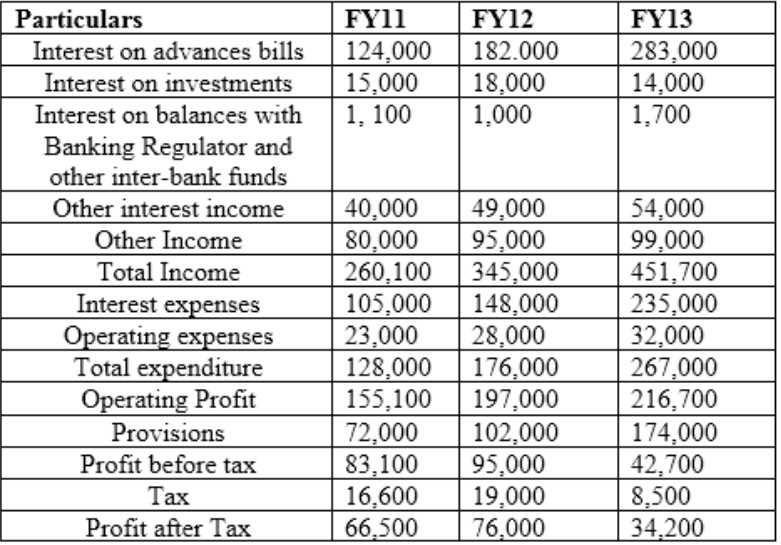
Profit and Loss Account
Balance Sheet
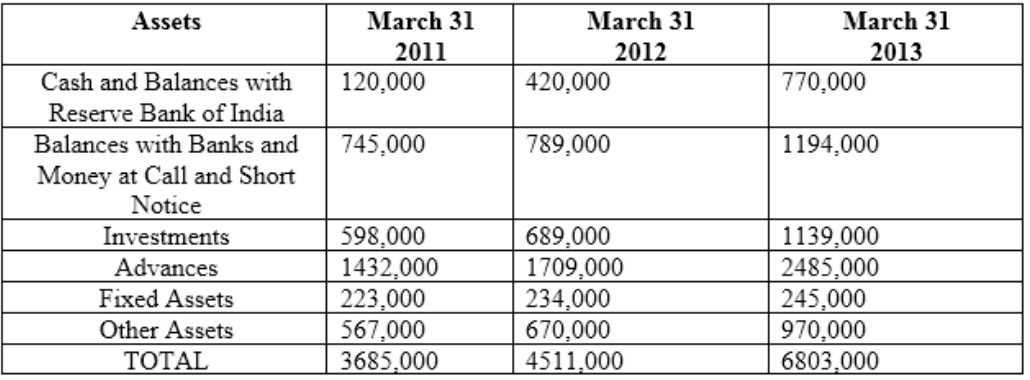
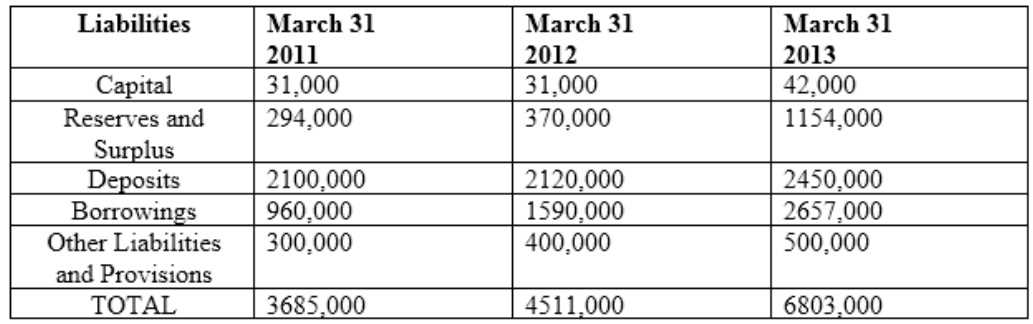
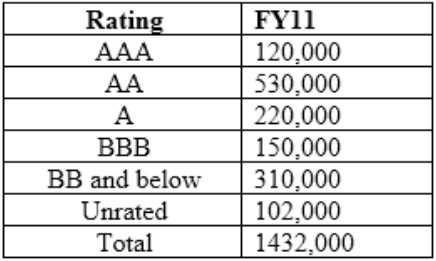
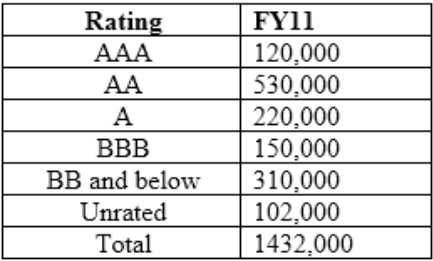
The rating wise break-up of assets for FY11 is as follows:
Cost to income ratio is best for which year
Auckland Ltd is a public sector bank operating with about 120 branches across Indi
a. The bank has been in business since 1971 and has about 40% branches in rural areas and about
75% of all branches are in
Western India. On the basis of the size, Auckland Ltd will be ranked at number 31 amongst 40 banks
in India.
Although top management has appointment period of 5 years, generally they retire on ach sieving
age of 60 years with an average tenure of only 2 years at the top job.
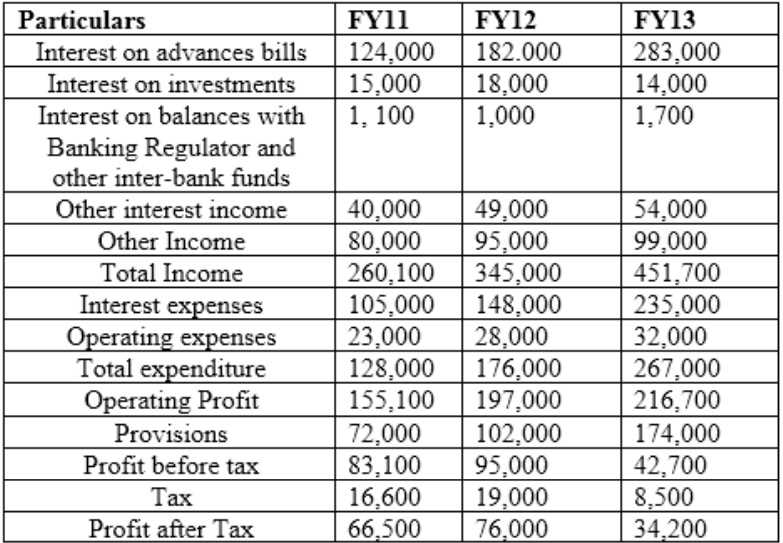
Profit and Loss Account
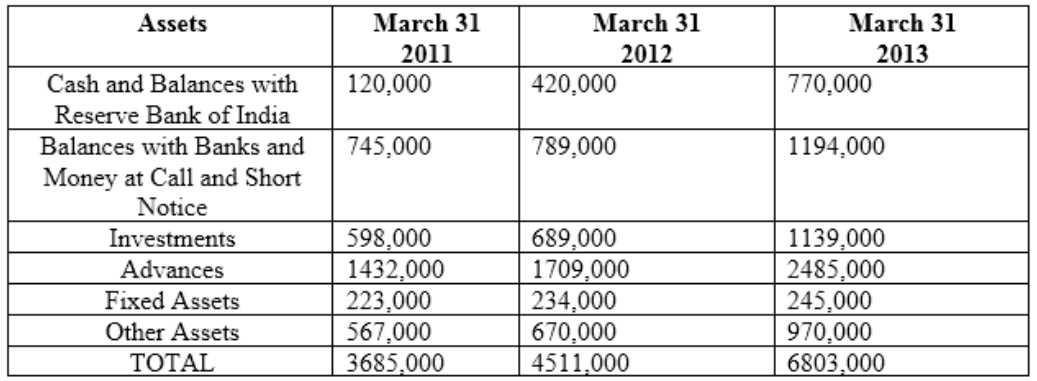
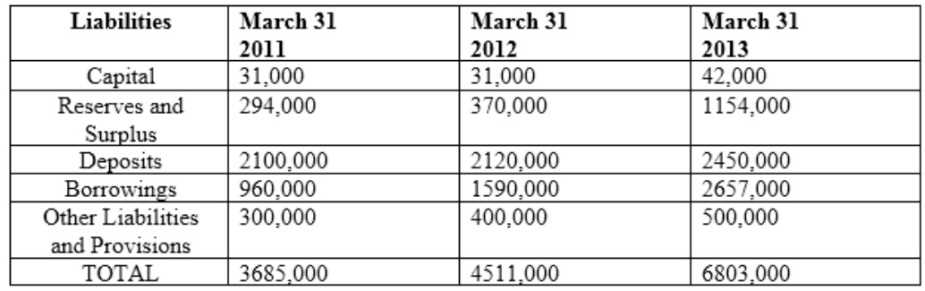
Balance Sheet
The rating wise break-up of assets for FY11 is as follows:
During which year amongst the three, was the overall financial profile of bank most string?
Further following information is available about a particular bond ‘Bond F’
There is a 10.25% risky bond with a maturity of 2.25% year(s) its current price is INR105.31, which
corresponds to YTM of 9.22%. The following are the benchmark YTMs.

Compute interpolated spread for Bond F based on the information provided in the vignette:
ratios will remain unchanged, if all other things remain constant?
power project on river Shivna in Madhya Pradesh (MP). The project is also of relevance from the
irrigation perspective due to its location and as per the agreement MCC will have to undertake
construction of web of canals, approach road to dam, power house and other ancillary units. MCC is
promoted by Mr. Thomas Mark, who is a MP from the ruling party which recently formed
government in MP. Historically, MCC has been engaged into construction of rural roads, small bridges
and railway platforms on contract basis for the Government. MCC will have a separate special
purpose vehicle (SPV) floated for this venture.
The hydro power project comes under the public private partnership scheme of the Government of
MP, where in the private partner builds owns operates and transfers (BOOT) the hydro power plant.
The detailed terms of the hydro power project agreement are as follows:
1. The construction of the dam, canals and hydro power plant shall be undertaken by the contractor.
The
Government of MP will have to acquire land which will submerge on construction of dam and shall
rehabilitate the owners of land.
2. MCC shall have right to operate the hydro power project from date of commencement of
commercial operations (DCCO) for a period of 20 years and shall transfer the project to Government
thereafter. Further,
SPV shall be tax exempt for a period of five years from DCCO i.e. FY17-FY21.
3. The power project is of 600 megawatts (MW) shall comprise 4 units of 150 MW each. The
estimated cost of project is about INR3, 500 Million to be spent over a period of 4 year(s) the project
is estimated to be commercially operational by April 1, 2016 with two units operational om same day
and one unit each will be operational on April 1, 2017 and April 1, 2018.
4. Means of finance:

Means of Finance INR Million
Government Aid (To be classified as Equity) 500Equity 900 Debt 2100
5. Amount if expenditure estimated in various years is as follows:

Debt shall bear a fixed rate of interest of 10% and all interest till DCCO shall be added to the
principal. The expected principal along with capitalized interest is expected to be INR2, 400 Million
(i.e.INR2100 Million debt plus INR300 Million capitalized interest). The repayment of the same shall
be in 12 equated annual installments starting from FY17.
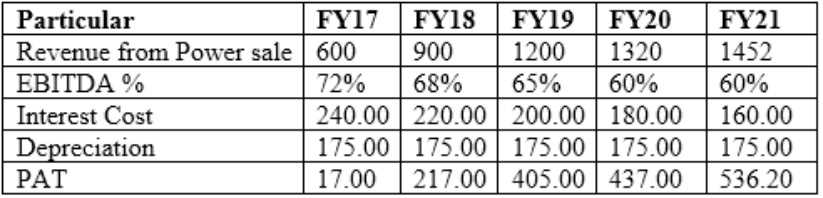
Brief projections for the period of FY17 to FY21 are given below:
Developments as on March 31, 2015
The project manager for the SPV made following comments at a press conferee on March 31, 2015:
As you all are aware, we were running bang on schedule till we last met on December 21, 2014. From
today we are just left with one more year to complete the project in time. However, the flash floods
which struck our dam site on this March 15, 2015 have created havoc in the region. I shall not point
out the loss of lives in the region as you all are well aware of those. Our project has also been badly
hit due to the same and we have been assessing the damage over the last one week. After analyzing
damage, we have made changes in project schedule. Now we will be making only one unit of 150
MW operational on April 1, 2016 and 1 unit each will be added in each of subsequent year(s).
Development as on September 30, 2015
Post the flash floods, lot of environmentalists started raising issues of changes in environment due to
construction of large number of dams. A few Public Interest Litigations (PILs) have been filed in
various courts.
Honorable High Court of MP on September 27, 2015, banned construction of any dams in the region
and banned permissions for new dams till next hearing scheduled on November 30, 2015. MCC in its
press release has indicated that they will apply to the higher court on the matter.
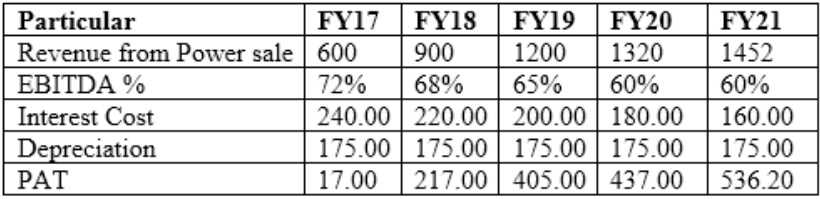
After the developments of March 31, 2015, assuming revenues are directly linked to the power
production and the EBITDA margins remain intact for the year, as were projected, compute the
revised interest coverage ratio dfor FY17 and FY18?
providing off-shore analytical services. They all operate on the labour cost-arbitrage in India and the
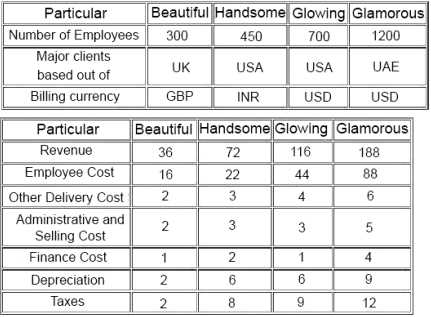
countries of their clients. Following information pertains for the year ended March 31, 2013.
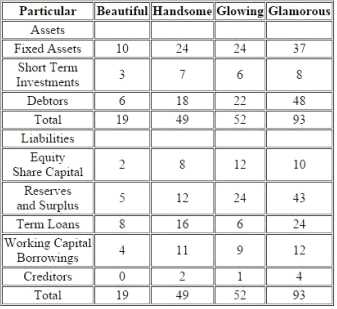
The year FY13, was typically a good year for Indian IT companies. For FY14, the economic analysts
have given following predictions about the IT Industry:
A) It is expected that INR will appreciate sharply against other USD.
B) Given high inflation and attrition in IT Industry in India, the wages of IT sector employees will
increase more sharply than Inflation and general wage rise in country.
C) US Congress will be passing a bill which restricts the outsourcing to third world countries like
India.
While analyzing the four entities, you come across following findings related to Glowing:
Glowing is promoted by Mr.M R Bhutta, who has earlier promoted two other business ventures, He
started with ABC Entertainment Ltd in 1996 and was promoter and MD of the company. ABC was a
listed entity and
its share price had sharp movements at the time of stock market scam in late 1990s. In 1999,
Mr.Bhutta sold his entire stake and resigned from the post of MD. The stock price declined by about
90% in coming days and has never recovered. Later on in 2003, Mr.Bhutta again promoted a new
business, Klear Publications Ltd (KCL) an in the business of magazine publication. The entity had
come out with a successful IPO and raised money from public. Thereafter it ran into troubles and
reported losses. In 2009, Mr.Bhutta went on to exit this business as well by selling stake to other
promoter(s). There have been reports in both instances with allegations that promoters have
siphoned off money from listed entities to other group entities, however, nothing has been proved in
any court.”
Which of the following risks do not exist for Indian IT industry?
A: Factor pays a percentage of the invoice face value to the seller at the time of sale
B: The remainder of the purchase price is held by factor until the payment by the account debtor is
made.
C: The cost associated with the transaction is paid upfront by the seller to the factoring agent.
FlyHigh
Airlines Ltd, a company operating chartered aircrafts in Indi
a. As she was heading for a meeting with her superior on the matter, coffee spilled over her set of
prepared paper(s). As she was getting late for meeting, instead of preparing entire set she could
recollect few numbers from her memory and reconstructed following partial financial table:
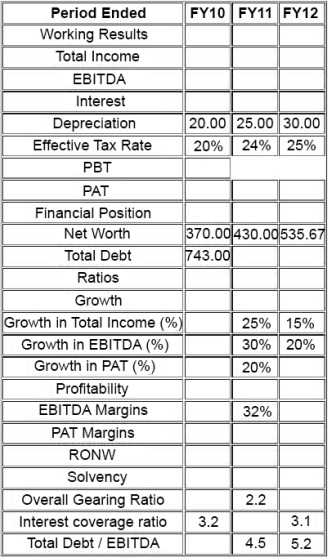
Compute growth in PAT for FY12?
power project on river Shiva in Madhya Pradesh (MP). The project is also of relevance from the
irrigation perspective due to its location and as per the agreement MCC will have to undertake
construction of web of canals, approach road to dam, power house and other ancillary units. MCC is
promoted by Mr. Thomas Mark, who is a MP from the ruling party which recently formed
government in MP. Historically, MCC has been engaged into construction of rural roads, small bridges
and railway platforms on contract basis for the Government. MCC will have a separate special
purpose vehicle (SPV) floated for this venture.
The hydro power project comes under the public private partnership scheme of the Government of
MP, where in the private partner builds owns operates and transfers (BOOT) the hydro power plant.
The detailed terms of the hydro power project agreement are as follows:1. The construction of the
dam, canals and hydro power plant shall be undertaken by the contractor. The
Government of MP will have to acquire land which will submerge on construction of dam and shall
rehabilitate the owners of land.
2. MCC shall have right to operate the hydro power project from date of commencement of
commercial operations (DCCO) for a period of 20 years and shall transfer the project to Government
thereafter. Further,
SPV shall be tax exempt for a period of five years from DCCO i.e. FY17-FY21.
3. The power project is of 600 megawatts (MW) shall comprise 4 units of 150 MW each. The
estimated cost of project is about INR3, 500 Million to be spent over a period of 4 year(s) the project
is estimated to be commercially operational by April 1, 2016 with two units operational om same day
and one unit each will be operational on April 1, 2017 and April 1, 2018.
4. Means of finance:

Means of Finance INR Million
Government Aid (To be classified as Equity) 500Equity 900 Debt 2100
5. Amount if expenditure estimated in various years is as follows:

Debt shall bear a fixed rate of interest of 10% and all interest till DCCO shall be added to the
principal. The expected principal along with capitalized interest is expected to be INR2, 400 Million
(i.e.INR2100 Million debt plus INR300 Million capitalized interest). The repayment of the same shall
be in 12 equated annual installments starting from FY17.
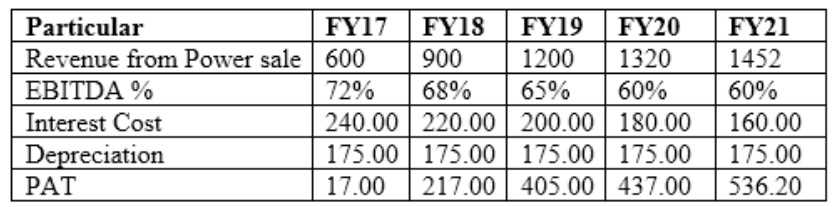
Brief projections for the period of FY17 to FY21 are given below:
Developments as on March 31, 2015
The project manager for the SPV made following comments at a press conferee on March 31, 2015:
As you all are aware, we were running bang on schedule till we last met on December 21, 2014. From
today we are just left with one more year to complete the project in time. However, the flash floods
which struck our dam site on this March 15, 2015 have created havoc in the region. I shall not point
out the loss of lives in the region as you all are well aware of those. Our project has also been badly
hit due to the same and we have been assessing the damage over the last one week. After analyzing
damage, we have made changes in project schedule. Now we will be making only one unit of 150
MW operational on April 1, 2016 and 1 unit each will be added in each of subsequent year(s).
Development as on September 30, 2015
Post the flash floods, lot of environmentalists started raising issues of changes in environment due to
construction of large number of dams. A few Public Interest Litigations (PILs) have been filed in
various courts.
Honorable High Court of MP on September 27, 2015, banned construction of any dams in the region
and banned permissions for new dams till next hearing scheduled on November 30, 2015. MCC in its
press release has indicated that they will apply to the higher court on the matter.
Based on the initial projections, do scenario analysis assuming only 75% capacity is utilized in FY17
and FY18 and thereby revenues will be proportionally reduced.
Compute DSCR under such scenario for FY17 and FY18, assuming other things remain constant?
power project on river Shivna in Madhya Pradesh (MP). The project is also of relevance from the
irrigation perspective due to its location and as per the agreement MCC will have to undertake
construction of web of canals, approach road to dam, power house and other ancillary units. MCC is
promoted by Mr. Thomas Mark, who is a MP from the ruling party which recently formed
government in MP. Historically, MCC has been engaged into construction of rural roads, small bridges
and railway platforms on contract basis for the Government. MCC will have a separate special
purpose vehicle (SPV) floated for this venture.
The hydro power project comes under the public private partnership scheme of the Government of
MP, where in the private partner builds owns operates and transfers (BOOT) the hydro power plant.
The detailed terms of the hydro power project agreement are as follows:
1. The construction of the dam, canals and hydro power plant shall be undertaken by the contractor.
The
Government of MP will have to acquire land which will submerge on construction of dam and shall
rehabilitate the owners of land.
2. MCC shall have right to operate the hydro power project from date of commencement of
commercial operations (DCCO) for a period of 20 years and shall transfer the project to Government
thereafter. Further,
SPV shall be tax exempt for a period of five years from DCCO i.e. FY17-FY21.
3. The power project is of 600 megawatts (MW) shall comprise 4 units of 150 MW each. The
estimated cost of project is about INR3, 500 Million to be spent over a period of 4 year(s) the project
is estimated to be commercially operational by April 1, 2016 with two units operational on same day
and one unit each will be operational on April 1, 2017 and April 1, 2018.
4. Means of finance:

Means of Finance INR Million
Government Aid (To be classified as Equity) 500Equity 900 Debt 2100
5. Amount if expenditure estimated in various years is as follows:

Debt shall bear a fixed rate of interest of 10% and all interest till DCCO shall be added to the
principal. The expected principal along with capitalized interest is expected to be INR2, 400 Million
(i.e.INR2100 Million debt plus INR300 Million capitalized interest). The repayment of the same shall
be in 12 equated annual installments starting from FY17.
Brief projections for the period of FY17 to FY21 are given below:
Developments as on March 31, 2015
The project manager for the SPV made following comments at a press conferee on March 31, 2015:
As you all are aware, we were running bang on schedule till we last met on December 21, 2014. From
today we are just left with one more year to complete the project in time. However, the flash floods
which struck our dam site on this March 15, 2015 have created havoc in the region. I shall not point
out the loss of lives in the region as you all are well aware of those. Our project has also been badly
hit due to the same and we have been assessing the damage over the last one week. After analyzing
damage, we have made changes in project schedule. Now we will be making only one unit of 150
MW operational on April 1, 2016 and 1 unit each will be added in each of subsequent year(s).
Development as on September 30, 2015
Post the flash floods, lot of environmentalists started raising issues of changes in environment due to
construction of large number of dams. A few Public Interest Litigations (PILs) have been filed in
various courts.
Honorable High Court of MP on September 27, 2015, banned construction of any dams in the region
and banned permissions for new dams till next hearing scheduled on November 30, 2015. MCC in its
press release has indicated that they will apply to the higher court on the matter.
As a credit analyst on March 31, 2012, which of the following sets of risks are you going to put in your
credit appraisal note?