Home/aacn/Free AACN CCRN (Adult) Direct Care Pathway Actual Exam Questions
Free AACN CCRN (Adult) Direct Care Pathway Actual Exam Questions
The questions for this exam were last updated on January 7, 2026
Dumps Box (DumpsBox) offers up-to-date practice exam questions for CCRN certification exam which are developed and validated by AACN subject domain experts certified in AACN CCRN (Adult) Direct Care Pathway . These practice questions are update regularly as we keep an eye on any recent changes in CCRN syllabus, and when there is update our team quickly adjusts the questions. This commitment to providing the best quality exam prep material to certification aspirants is what makes DumpsBox.com the best certification exam prep website. On top of that, our strong, yet strictly moderated, community based feedback keeps the content clean and current. Each question has helpful community discussion that provides it extra perspective and introduces helpful resources for better exam preparation. This also saves students from other outdated practice questions or illicit exam dumps that can have adverse affects on career. Browse through our AACN CCRN (Adult) Direct Care Pathway exam questions and pass your exam on first try.
Treatment of cerebral vasospasm includes administration of
Select one option, then reveal solution.
Question No. 2
A patient with acute renal failure has a serum potassium level of 7.2 mEq/L. The most appropriate immediate intervention for this patient is
Select one option, then reveal solution.
Question No. 3
A patient with cardiogenic shock for several days has been managed aggressively with vasopressor and inotrope therapies. Which of the following indicates organ dysfunction from hypoperfusion?
Select one option, then reveal solution.
Question No. 4
A nurse who is providing care to a patient with a hemorrhagic stroke receives an order to administer 3% Normal Saline IV. The nurse should recognize the goal of therapy is to create an
Select one option, then reveal solution.
Question No. 5
The family of a patient with trauma believes that the patient is in pain and requests that a neighbor, a therapeutic touch practitioner, be allowed to see the patient. Unit policy allows visits by immediate family only. Which of the following is the most important consideration in a nurse's decision about facilitating the visit?
Select one option, then reveal solution.
Question No. 6
A nurse is caring for a patient with pulmonary fibrosis who is exhibiting shortness of breath, tachypnea, and feels a sense of impending doom. In order to relieve these symptoms, the nurse should anticipate an order for
Select one option, then reveal solution.
Question No. 7
The most appropriate therapy for carboxyhemoglobinemia is
Select one option, then reveal solution.
Question No. 8
While recording hourly ventilator checks on a patient who is being mechanically ventilated, the nurse notes that the PIP has gradually increased by 5 cm H2O over the past 4 hours. This increase indicates
Select one option, then reveal solution.
Question No. 9
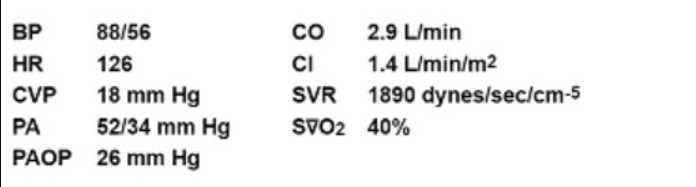
A patient with an acute anterior wall MI presents with an S3 gallop and the following values: Which drug therapy would be most appropriate for this patient?
Select one option, then reveal solution.
Question No. 10
Following a splenectomy, a patient is most at risk for
Select one option, then reveal solution.
Question No. 11
Which of the following are physiologic effects of pulmonary contusion?
Select one option, then reveal solution.
Question No. 12
The rationale for initiating early enteral feeding in a patient with sepsis is to
Select one option, then reveal solution.
Question No. 13
An experienced nurse new to a unit believes the literature does not support current unit practice of a fixed-dose nitroglycerin IV (Tridil) infusion in all postoperative cardiac surgery patients for 24 hours. The nurse develops a proposal referencing peer-reviewed articles. Based on the proposal, unit leaders agree to remove the nitroglycerin IV (Tridil) infusion from the standard order set. The actions taken by the nurse are best described as
Select one option, then reveal solution.
Question No. 14
For a patient who sustained blunt renal trauma and a crush injury to the leg, monitoring should include observing for
Select one option, then reveal solution.
Question No. 15
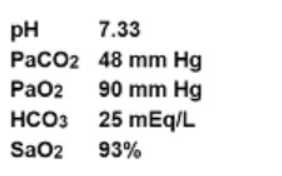
A patient admitted with a diagnosis of pneumonia has a temperature of 103.2° F (39.5° C) and copious pulmonary secretions. ABG results drawn on room air are: The nurse should expect that hemoglobin's affinity for oxygen in this patient to be